English
 Español
 tiếng việt
 русский
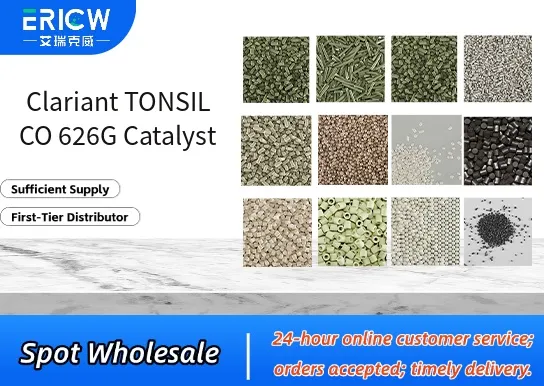
Highly selective acid catalyst optimized for condensation and esterification reactions.
Thermally stable solid with low leaching risk, enabling cleaner downstream processing.
Non-corrosive alternative to liquid mineral acids, improving operational safety and equipment longevity.
Easy-to-handle granular form facilitating uniform dispersion and simplified reactor charging.
Consistent batch-to-batch performance supported by Clariant’s stringent quality control protocols.
Production of plasticizers such as dioctyl phthalate (DOP) and diisononyl phthalate (DINP).
Ester synthesis for fragrance and flavor intermediates.
Manufacturing of polyester resins and alkyd binders.
Catalysis in biodiesel transesterification processes (as a co-catalyst or process enhancer).
Dehydration reactions in fine chemical synthesis, including acetal and ketal formation.
| Chemical Type | Solid acidic clay-based catalyst |
| Product Form | Free-flowing granules |
| Appearance | Light beige to pale brown granules |
| Primary Applications | Esterification, condensation, dehydration |
| Key Features | Non-corrosive, thermally stable, low metal content |
| Benefits | Reduced waste generation, simplified separation, reusable in fixed-bed systems |
| Storage Conditions | Store in dry, well-ventilated area; protect from moisture |
| Regulatory Compliance | REACH registered; compliant with FDA 21 CFR §173.350 for indirect food contact (when specified) |
Q1: What is the primary function of TONSIL CO 626G in polymer processing?
A: TONSIL CO 626G is a high-activity, acid-treated bentonite-based catalyst designed to promote condensation reactions—particularly in silicone and polyurethane systems—by enhancing crosslinking efficiency and improving cure kinetics under ambient or mild thermal conditions.
Q2: Is TONSIL CO 626G compatible with moisture-cure silicone formulations?
A: Yes, it is specifically formulated for use in one-component moisture-curing silicones, where it acts as a selective catalyst to accelerate the reaction between silanol groups and atmospheric moisture without inducing premature gelation or compromising shelf life.
Q3: How should TONSIL CO 626G be incorporated into a formulation?
A: It is typically dispersed homogeneously into the base polymer or prepolymer phase using standard high-shear mixing equipment. Pre-dilution in a compatible carrier fluid may be recommended for optimal dispersion, especially in viscous systems.
Q4: Does TONSIL CO 626G affect the final physical properties of cured elastomers?
A: When used at recommended dosage levels, it supports consistent network formation and generally contributes to improved tensile strength and elongation balance, while maintaining good thermal stability and low compression set in the final vulcanizate.
Contact With Us:
E-mail: wangxingqiang@ericwchem.com
Have a Questions? Call Us:
Add:
Building A1, Jiete Industrial Park, Huangpu District, Guangzhou City, Guangdong Province, China