English
 Español
 tiếng việt
 русский
Highly selective acidic clay-based catalyst optimized for alkylation and acylation reactions.
Controlled surface acidity and uniform pore structure ensure consistent reaction performance and reduced by-product formation.
Thermally stable up to 300 °C, enabling robust operation in continuous fixed-bed processes.
Low dust generation and excellent mechanical strength for extended service life and minimal pressure drop.
Free-flowing granular form with narrow particle size distribution for uniform bed packing and optimal mass transfer.
Friedel–Crafts alkylation of aromatic hydrocarbons (e.g., benzene with propylene to produce cumene).
Acylation of phenols and anilines for fine chemical intermediates in pharmaceuticals and agrochemicals.
Dehydration and isomerization of C4–C5 olefins in petrochemical refining streams.
Esterification and transesterification reactions in bio-lubricant and plasticizer synthesis.
Condensation reactions for specialty resins and functional polymers.
| Chemical Type | Acid-activated montmorillonite clay |
| Product Form | Granules |
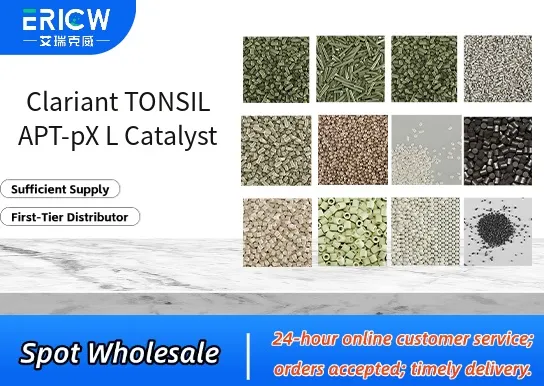
| Appearance | Light grey to beige free-flowing granules |
| Primary Applications | Alkylation, acylation, isomerization, esterification |
| Key Features | Controlled Brønsted/Lewis acidity, high surface area, thermal stability |
| Benefits | Reduced corrosion risk vs. liquid acids, no neutralization waste, easy handling and regeneration |
| Typical Bulk Density | 0.65–0.75 g/cm³ |
| Particle Size Range | 1.6–3.35 mm |
Q1: What is the primary function of TONSIL APT-pX L in polymer processing?
A: TONSIL APT-pX L is a highly dispersed, surface-modified acid-activated bentonite clay catalyst designed to promote controlled crosslinking and condensation reactions—particularly in silicone-based systems and certain thermoset resins—enhancing thermal stability and mechanical performance without compromising processability.
Q2: Is TONSIL APT-pX L compatible with food-contact or pharmaceutical-grade formulations?
A: While TONSIL APT-pX L is manufactured under strict quality control and is widely used in industrial elastomer and coating applications, it is not pre-qualified for direct food-contact or pharmaceutical use. End-use compliance must be verified through full regulatory assessment by the formulator, including extractables testing and migration evaluation appropriate to the final application.
Q3: How should TONSIL APT-pX L be incorporated into a formulation?
A: It is typically added during high-shear mixing stages—such as masterbatch preparation or two-roll mill processing—to ensure uniform dispersion. Pre-drying is generally not required, but storage under dry conditions is recommended to maintain optimal reactivity and handling characteristics.
Q4: Does TONSIL APT-pX L require activation before use?
A: No—TONSIL APT-pX L is supplied in a ready-to-use, pre-activated form. Its surface chemistry has been optimized during manufacturing to deliver consistent catalytic activity without additional thermal or chemical activation steps.
Contact With Us:
E-mail: wangxingqiang@ericwchem.com
Have a Questions? Call Us:
Add:
Building A1, Jiete Industrial Park, Huangpu District, Guangzhou City, Guangdong Province, China