English
 Español
 tiếng việt
 русский
Highly selective cobalt-based catalyst for controlled oxidation reactions.
Thermally stable up to 120 °C, enabling robust performance in continuous processes.
Low metal leaching ensures long-term activity and minimal downstream contamination.
Soluble in common organic solvents including xylene, toluene, and esters.
Consistent batch-to-batch reproducibility certified per ISO 9001 manufacturing standards.
Autoxidation of alkenes and alkyl aromatics in fine chemical synthesis.
Curing of unsaturated polyester resins (UPR) for composites and gel coats.
Oxidative crosslinking in alkyd resin production for high-performance coatings.
Accelerated drying of linseed oil-based inks and architectural paints.
Controlled radical initiation in polymer modification and functionalization.
| Chemical Type | Cobalt(II) naphthenate solution |
| Product Form | Liquid concentrate |
| Appearance | Clear, reddish-brown homogeneous liquid |
| Cobalt Content (as Co) | 6.0 ± 0.3 wt% |
| Solvent Base | Aromatic hydrocarbon mixture (C9–C10) |
| Density at 20 °C | 0.92–0.95 g/cm³ |
| Flash Point (Closed Cup) | 62 °C |
| Storage Stability | ≥24 months unopened at 15–25 °C |
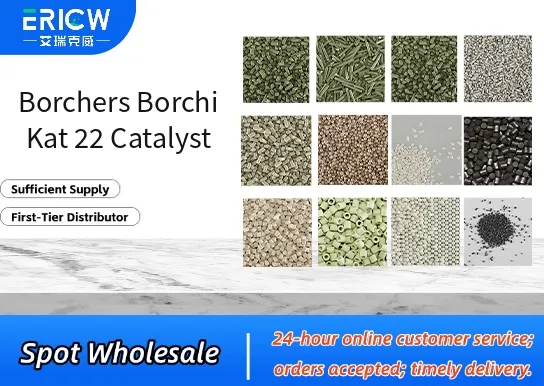
Q1: What is the primary function of Borchi Kat 22 in coating and ink formulations?
A: Borchi Kat 22 is a cobalt-free, heavy-metal-free drier catalyst designed to accelerate the oxidative crosslinking of alkyd resins and other air-drying binders. It promotes efficient surface and through-dry without compromising film clarity or long-term stability.
Q2: Is Borchi Kat 22 suitable for use in low-VOC or high-solids systems?
A: Yes — Borchi Kat 22 is formulated to perform effectively in modern low-VOC, high-solids, and solvent-reduced coatings. Its compatibility with common co-solvents and resin systems supports formulation flexibility without requiring significant process adjustments.
Q3: How does Borchi Kat 22 compare to traditional cobalt-based driers in terms of drying profile?
A: Unlike cobalt driers that primarily drive rapid surface dry, Borchi Kat 22 delivers a more balanced drying profile—supporting both timely surface set and robust through-dry. This reduces the risk of wrinkling, dust pickup, or delayed handling while maintaining excellent film integrity.
Q4: What is the recommended dosage range for Borchi Kat 22?
A: Dosage depends on formulation requirements, binder type, and desired drying speed, but it is typically used at low concentrations—generally ranging from 0.1% to 2% by weight relative to total non-volatile content. Optimization via small-scale trials is recommended for each specific system.
Q5: Can Borchi Kat 22 be used alongside other driers or catalysts?
A: Yes — Borchi Kat 22 is compatible with many auxiliary driers (e.g., zirconium or calcium-based systems) and can be used in combination to fine-tune drying behavior. However, compatibility testing is advised when blending with strong oxidizing agents or highly reactive metal soaps.
Contact With Us:
E-mail: wangxingqiang@ericwchem.com
Have a Questions? Call Us:
Add:
Building A1, Jiete Industrial Park, Huangpu District, Guangzhou City, Guangdong Province, China