English
 Español
 tiếng việt
 русский
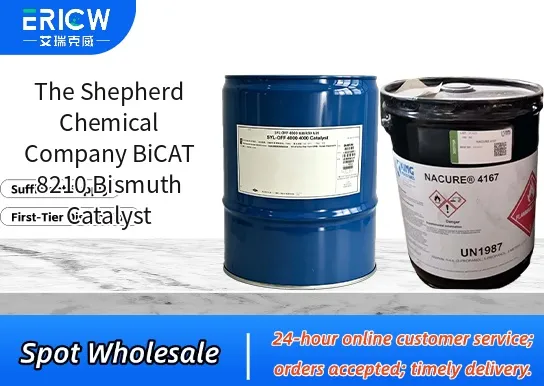
Non-toxic bismuth-based alternative to traditional heavy-metal catalysts such as lead and tin.
High catalytic activity for urethane and polyester polyol reactions at mild processing temperatures.
Excellent hydrolytic stability, ensuring consistent performance in moisture-sensitive formulations.
Low volatility and minimal odor, supporting safer handling and improved workplace air quality.
Compatible with common polyurethane systems including flexible foams, coatings, and adhesives.
Flexible polyurethane slabstock and molded foam manufacturing.
Waterborne polyurethane dispersions (PUDs) for coatings and textile finishes.
Two-component polyurethane sealants and elastomers.
High-solids polyurethane coatings for industrial and automotive applications.
Reaction injection molding (RIM) and structural foam formulations.
| Chemical Type | Bismuth carboxylate complex |
| Product Form | Clear to slightly hazy liquid |
| Appearance | Amber to light brown liquid |
| Primary Applications | Polyurethane foam, coatings, adhesives, sealants |
| Key Features | Heavy-metal-free, low-VOC, non-curing inhibitor |
| Benefits | Regulatory compliance support (REACH, TSCA), reduced formulation toxicity |
| Solubility | Compatible with common polyols, solvents, and isocyanates |
| Storage Conditions | Store in original container at 15–30°C; protect from freezing and excessive heat |
Q1: What is the primary function of BiCAT 8210 in polyurethane systems?
A: BiCAT 8210 is a bismuth-based catalyst designed to promote urethane formation (reaction between isocyanates and polyols) with high selectivity and reduced side reactions, offering improved processing control and gel-time predictability compared to traditional tin catalysts.
Q2: How does BiCAT 8210 compare to dibutyltin dilaurate (DBTDL) in terms of regulatory compliance and handling safety?
A: As a non-tin, heavy-metal-free alternative, BiCAT 8210 avoids the regulatory restrictions and handling concerns associated with organotin compounds, supporting formulators seeking more sustainable and globally acceptable catalyst options without compromising catalytic efficiency.
Q3: Is BiCAT 8210 compatible with moisture-cure or one-component polyurethane systems?
A: Yes — BiCAT 8210 demonstrates good compatibility in moisture-cure formulations, where it helps accelerate the reaction of isocyanate groups with ambient moisture while maintaining shelf stability when properly formulated and packaged.
Q4: What is the typical dosage range for BiCAT 8210 in flexible slabstock foam applications?
A: Dosage depends on formulation requirements and desired reactivity profile, but BiCAT 8210 is typically used at low concentrations — generally ranging from 0.1% to 2% by weight relative to the polyol component — and often functions effectively at the lower end of this range when optimized.
Contact With Us:
E-mail: wangxingqiang@ericwchem.com
Have a Questions? Call Us:
Add:
Building A1, Jiete Industrial Park, Huangpu District, Guangzhou City, Guangdong Province, China