English
 Español
 tiếng việt
 русский
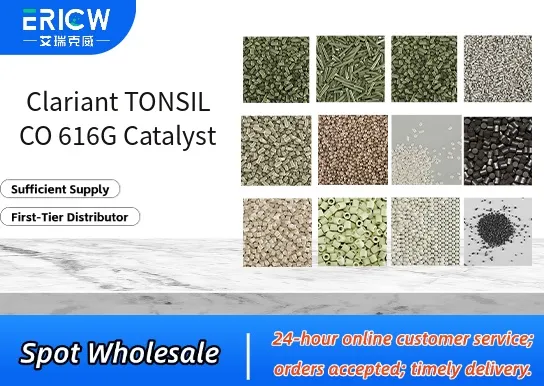
Highly selective acidic clay-based catalyst for controlled condensation and alkylation reactions.
Thermally stable up to 250 °C, enabling robust performance in continuous fixed-bed processes.
Consistent particle size distribution ensures uniform flow dynamics and reduced pressure drop in reactors.
Low metal impurity content minimizes undesired side reactions and extends catalyst cycle life.
Regenerable via controlled thermal treatment, supporting sustainable operation and cost efficiency.
Friedel–Crafts alkylation of aromatic hydrocarbons in fine chemical synthesis.
Dehydration and cyclization steps in fragrance and flavor intermediate manufacturing.
Condensation of carbonyl compounds for specialty resin precursors.
Isomerization of linear alkenes in lubricant additive production.
Polymerization initiation for low-molecular-weight polyolefin modifiers.
| Chemical Type | Acid-activated bentonitic clay |
| Product Form | Granular solid |
| Appearance | Light grey to beige granules |
| Particle Size Range | 1.6 – 3.35 mm |
| Bulk Density | 0.75 – 0.85 g/cm³ |
| Surface Area (BET) | 220 – 260 m²/g |
| Acid Strength (Hammett H₀) | −3.5 to −4.2 |
| Moisture Content (max.) | 5.0 wt.% |
Q1: What is the primary function of TONSIL CO 616G in polymer processing?
A: TONSIL CO 616G is a highly active, acid-activated bentonite-based catalyst designed to promote crosslinking and condensation reactions—particularly in silicone rubber and RTV formulations—enhancing cure speed, green strength, and final mechanical properties.
Q2: Is TONSIL CO 616G compatible with platinum-catalyzed silicone systems?
A: No—TONSIL CO 616G is an acidic clay catalyst and is not recommended for use in platinum-cured (hydrosilylation) systems, as it may poison the platinum catalyst or cause premature gelation. It is best suited for tin-catalyzed or peroxide-initiated formulations.
Q3: How should TONSIL CO 616G be incorporated into a formulation?
A: It is typically added during the high-shear mixing stage, either pre-dispersed in a carrier fluid or blended directly into the base polymer. Good dispersion is essential to ensure uniform catalytic activity and avoid localized over-cure or surface defects.
Q4: Does TONSIL CO 616G require drying or thermal activation before use?
A: While not strictly required, pre-drying at moderate temperatures (e.g., 100–120 °C under vacuum) may improve consistency in moisture-sensitive applications, as residual water can interfere with condensation curing mechanisms.
Contact With Us:
E-mail: wangxingqiang@ericwchem.com
Have a Questions? Call Us:
Add:
Building A1, Jiete Industrial Park, Huangpu District, Guangzhou City, Guangdong Province, China