English
 Español
 tiếng việt
 русский
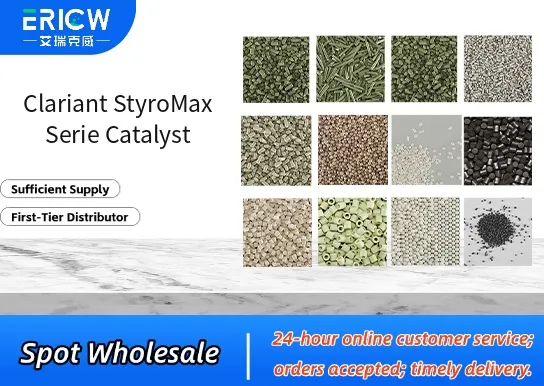
Highly selective for styrene production via dehydrogenation of ethylbenzene.
Enhanced thermal stability ensures extended catalyst lifetime under industrial operating conditions.
Low coke formation rate, minimizing downtime and regeneration frequency.
Optimized potassium–iron oxide formulation for improved activity and consistent performance.
Robust mechanical strength to withstand high-velocity vapor-phase reaction environments.
Styrene monomer (SM) manufacturing in fixed-bed adiabatic reactors.
Integrated ethylbenzene-to-styrene plants with steam co-feed systems.
Revamp and capacity upgrade projects for existing styrene units.
Energy-efficient retrofit applications targeting reduced steam consumption.
High-purity styrene production for polymer-grade specifications.
| Chemical Type | Potassium-promoted iron oxide-based catalyst |
| Product Form | Cylindrical extrudates (5 mm diameter × 5–10 mm length) |
| Appearance | Dark brown to black granular solid |
| Primary Applications | Dehydrogenation of ethylbenzene to styrene |
| Key Features | High selectivity, low by-product formation, stable activity over cycle life |
| Benefits | Reduced operating costs, longer run lengths, lower energy demand per ton of styrene |
| Storage Conditions | Store in dry, well-ventilated area; protect from moisture and physical damage |
| Handling Precautions | Use appropriate PPE; avoid inhalation of dust during loading/unloading |
Q1: What is the primary function of the StyroMax Serie catalysts in polystyrene production?
A: StyroMax Serie catalysts are designed to enhance polymerization efficiency and control molecular weight distribution during the production of general-purpose and high-impact polystyrene. They support consistent reaction kinetics and improved process stability under standard suspension or bulk polymerization conditions.
Q2: How does StyroMax differ from conventional peroxide-based initiators?
A: Unlike traditional peroxides, StyroMax catalysts offer tailored thermal decomposition profiles and improved compatibility with styrene monomer systems. This results in more predictable initiation behavior, reduced volatile by-product formation, and better suitability for continuous or semi-batch manufacturing environments.
Q3: Is StyroMax compatible with common additives used in polystyrene formulations?
A: Yes — StyroMax catalysts are formulated to be compatible with typical stabilizers, plasticizers, flame retardants, and impact modifiers used in polystyrene applications. Compatibility testing is recommended for specific formulation combinations to ensure optimal performance and absence of adverse interactions.
Q4: What are the recommended storage and handling conditions?
A: StyroMax catalysts should be stored in original sealed containers at cool, dry conditions, away from direct sunlight and sources of heat or ignition. Handling requires appropriate personal protective equipment (PPE), including gloves and safety glasses, due to their reactive nature. Always consult the Safety Data Sheet (SDS) before use.
Q5: Can StyroMax catalysts be used in food-contact polystyrene applications?
A: StyroMax catalysts are intended for industrial polymerization processes and are not inherently certified for food-contact use. Regulatory compliance for final articles depends on full system evaluation, including residual levels and migration behavior, and must be confirmed by the end-user in accordance with applicable regional requirements.
Contact With Us:
E-mail: wangxingqiang@ericwchem.com
Have a Questions? Call Us:
Add:
Building A1, Jiete Industrial Park, Huangpu District, Guangzhou City, Guangdong Province, China