English
 Español
 tiếng việt
 русский
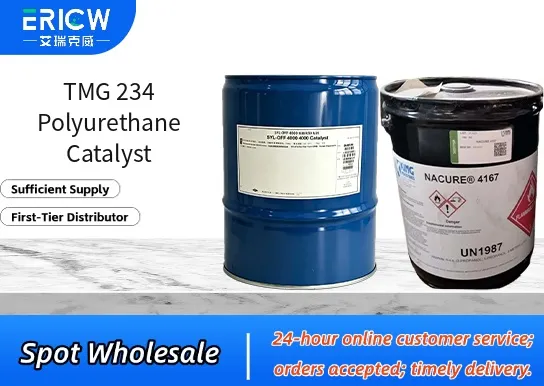
Highly selective tertiary amine catalyst optimized for balanced gelling and blowing reactions in flexible slabstock foams.
Low volatility and reduced amine odor, supporting improved workplace safety and compliance with industrial hygiene standards.
Excellent compatibility with polyether polyols and common isocyanates (e.g., TDI, MDI), ensuring stable formulation performance.
Enables precise control over cream time and rise profile, facilitating consistent foam density and cell structure.
Non-corrosive to processing equipment and compatible with standard metering and mixing systems.
Flexible polyurethane slabstock foams for bedding and furniture.
Automotive seating and interior trim foams requiring low-emission profiles.
High-resiliency (HR) foams with enhanced comfort and durability.
Conventional and water-blown molded foams for cushioning applications.
Composite foam systems where co-catalyst synergy with tin-based or other amine catalysts is required.
| Chemical Type | Tertiary amine (N,N,N′,N′-tetramethyl-1,3-butanediamine derivative) |
| Product Form | Liquid |
| Appearance | Clear, pale yellow liquid |
| Primary Applications | Gelling catalyst for flexible polyurethane foams |
| Key Features | Low volatility, low odor, high selectivity, good storage stability |
| Benefits | Improved process control, reduced VOC emissions, consistent foam quality |
| Recommended Dosage Range | 0.05–0.30 phr (parts per hundred parts polyol) |
| Storage Conditions | Store in original sealed container at 15–25°C, protect from moisture and direct sunlight |
Q1: What is the primary function of TMG 234 in polyurethane systems?
A: TMG 234 is a highly selective tertiary amine catalyst that primarily promotes the urethane reaction (isocyanate–polyol coupling), enabling improved gel time control and enhanced cell structure development in flexible and semi-rigid foams.
Q2: Is TMG 234 compatible with water-blown and low-emission foam formulations?
A: Yes, TMG 234 exhibits good compatibility with water-blown systems and supports low-VOC and low-amine-odor formulations due to its low volatility and reduced tendency to volatilize or migrate during processing and aging.
Q3: How does TMG 234 compare to traditional amine catalysts like DABCO 33LV in terms of processing window?
A: TMG 234 offers a broader processing window than many conventional catalysts, delivering more balanced reactivity between cream, gel, and tack-free times—particularly beneficial for complex molded parts and high-speed slabstock production.
Q4: What are typical handling and storage recommendations for TMG 234?
A: Store in original sealed containers at temperatures between 10 °C and 30 °C, away from moisture, strong oxidizing agents, and direct sunlight. Ensure adequate ventilation during handling, and refer to the Safety Data Sheet for detailed occupational hygiene guidance.
Contact With Us:
E-mail: wangxingqiang@ericwchem.com
Have a Questions? Call Us:
Add:
Building A1, Jiete Industrial Park, Huangpu District, Guangzhou City, Guangdong Province, China