English
 Español
 tiếng việt
 русский
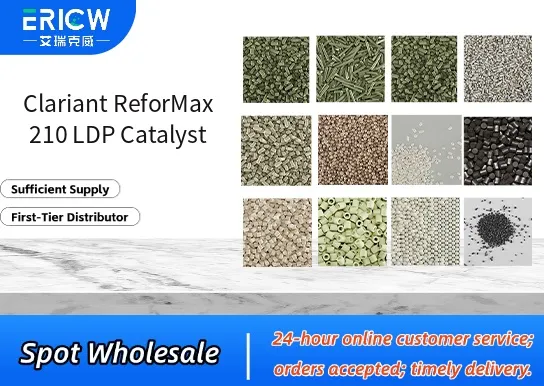
Highly selective low-pressure dehydrogenation catalyst for propane-to-propylene conversion.
Optimized thermal stability and resistance to sintering under cyclic regeneration conditions.
Enhanced coke resistance enabling longer cycle lengths and reduced regeneration frequency.
Consistent activity retention over multiple start-up/shutdown cycles in commercial LDP units.
Designed for seamless integration into existing Clariant ReforMax™ technology platforms.
Propane dehydrogenation (PDH) plants operating under low-pressure, continuous regeneration mode.
On-purpose propylene production for polypropylene and acrylic acid feedstock supply.
Integrated petrochemical complexes requiring high-purity propylene with minimal by-products.
New-build and revamp PDH facilities targeting improved energy efficiency and lower CO₂ footprint.
Flexible feedstock processing including mixed C3 streams with controlled impurity tolerance.
| Chemical Type | Supported chromium-based dehydrogenation catalyst |
| Product Form | Extrudates (cylindrical pellets, ~1.6–2.0 mm diameter) |
| Appearance | Gray to dark green free-flowing granular solid |
| Primary Applications | Low-pressure propane dehydrogenation (LDP) |
| Key Features | High selectivity, low methane/ethane formation, robust regenerability |
| Benefits | Extended run length, reduced catalyst replacement cost, stable propylene yield >85% |
| Handling | Non-hazardous; moisture-sensitive — store under dry inert atmosphere |
| Regeneration | Air/oxygen-based cyclic oxidation followed by controlled reduction |
Q1: What is the primary function of ReforMax 210 LDP in polyolefin processing?
A: ReforMax 210 LDP is a low-dust, free-flowing peroxide-based catalyst designed to initiate controlled rheology (CR) degradation of polypropylene and other polyolefins during extrusion or compounding, improving melt flow properties while maintaining mechanical performance.
Q2: How does the LDP (Low-Dust Pellet) form factor benefit industrial handling?
A: The spherical, free-flowing pellet format minimizes dust generation during dosing and mixing, enhancing operator safety, reducing equipment contamination, and enabling more consistent feeding in automated gravimetric systems compared to conventional powders or pastes.
Q3: Is ReforMax 210 LDP compatible with common polypropylene grades used in fiber, film, and injection molding applications?
A: Yes — it is widely used across homopolymer and copolymer PP grades, including those for spunbond and meltblown nonwovens, BOPP films, and thin-wall packaging. Compatibility should be verified under actual process conditions due to variations in stabilizer packages and thermal history.
Q4: What are key storage and handling recommendations?
A: Store in original sealed packaging at temperatures below 25 °C and protect from moisture, direct sunlight, and sources of heat or ignition. Avoid prolonged exposure to ambient air during handling, and use within recommended shelf life as indicated on the batch-specific label.
Contact With Us:
E-mail: wangxingqiang@ericwchem.com
Have a Questions? Call Us:
Add:
Building A1, Jiete Industrial Park, Huangpu District, Guangzhou City, Guangdong Province, China