English
 Español
 tiếng việt
 русский
Highly selective for polyolefin polymerization, enabling precise molecular weight distribution control.
Thermally stable under industrial reactor conditions, supporting extended catalyst lifetime and reduced fouling.
Consistent activity across batch and continuous processes, ensuring reproducible product quality.
Low residual metal content in final polymer, meeting stringent regulatory requirements for food-contact and medical-grade applications.
Compatible with common co-catalysts (e.g., alkylaluminum compounds) and supported on high-surface-area silica carriers.
Gas-phase polyethylene (HDPE, LLDPE) production.
Slurry-phase polypropylene homopolymer and copolymer synthesis.
Manufacture of impact-resistant polypropylene for automotive components.
Production of high-clarity random copolymer PP for packaging films and containers.
Customized polyolefin grades requiring narrow MWD or tailored comonomer incorporation.
| Chemical Type | Ziegler–Natta transition metal complex (Ti-based) |
| Product Form | Free-flowing powder |
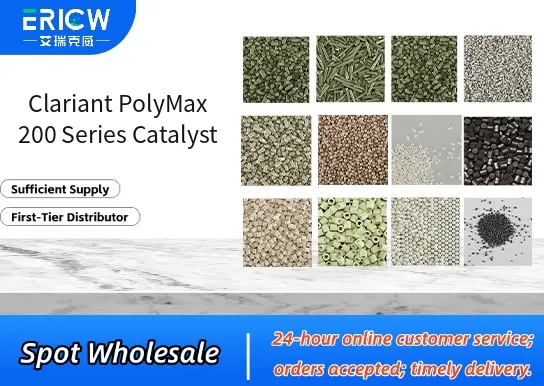
| Appearance | Gray to dark brown granular solid |
| Primary Applications | Polyethylene and polypropylene polymerization |
| Key Features | High stereoselectivity, low extractables, carrier-supported |
| Storage Conditions | Under inert atmosphere (N₂ or Ar), dry, <25 °C |
| Handling Precautions | Air- and moisture-sensitive; use in glovebox or purged system |
| Regulatory Status | REACH registered; compliant with FDA 21 CFR §177.1520 for food-contact polymers |
Q1: What is the primary function of the PolyMax 200 Series in polyolefin processing?
A: The PolyMax 200 Series is a high-performance catalyst system designed to enhance polymerization efficiency and control molecular weight distribution in polyolefin production, particularly for metallocene- or post-metallocene-based processes. It supports consistent catalyst activation and improved polymer microstructure uniformity.
Q2: Is the PolyMax 200 Series compatible with common co-catalysts and scavengers used in modern polyolefin plants?
A: Yes — it is engineered for compatibility with standard alkylaluminum co-catalysts (e.g., triethylaluminum, TIBAL) and common electron donors or scavengers. Performance may vary depending on system configuration, so compatibility testing under actual process conditions is recommended.
Q3: How does storage condition affect the stability and handling of PolyMax 200 Series catalysts?
A: These catalysts are sensitive to moisture and oxygen. They must be stored under inert atmosphere (e.g., nitrogen or argon), at controlled ambient temperatures, and protected from light. Handling should occur in gloveboxes or dry-air environments to maintain activity and prevent premature deactivation.
Q4: Can PolyMax 200 Series be used in slurry, gas-phase, or solution-phase polymerization processes?
A: It has been successfully applied across multiple reactor technologies — including slurry and gas-phase systems — and is adaptable to solution-phase configurations with appropriate support or carrier modifications. Optimal integration requires evaluation of reactor hydrodynamics and catalyst feeding methodology.
Contact With Us:
E-mail: wangxingqiang@ericwchem.com
Have a Questions? Call Us:
Add:
Building A1, Jiete Industrial Park, Huangpu District, Guangzhou City, Guangdong Province, China