English
 Español
 tiếng việt
 русский
Highly selective palladium-based catalyst optimized for low-temperature hydrogenation reactions.
Exceptional thermal and chemical stability under continuous industrial process conditions.
Low metal leaching performance, ensuring consistent activity and reduced downstream contamination.
Engineered for easy handling and safe integration into fixed-bed or slurry-phase reactor systems.
Reproducible batch-to-batch performance supported by Clariant’s stringent quality control protocols.
Selective hydrogenation of alkynes to alkenes in petrochemical feed purification.
Removal of trace acetylenes and dienes from C₂–C₄ olefin streams.
Catalytic saturation of nitro groups in fine chemical intermediates synthesis.
Hydrogenation of unsaturated carbonyl compounds in pharmaceutical API manufacturing.
| Chemical Type | Palladium on activated carbon |
| Product Form | Granular solid |
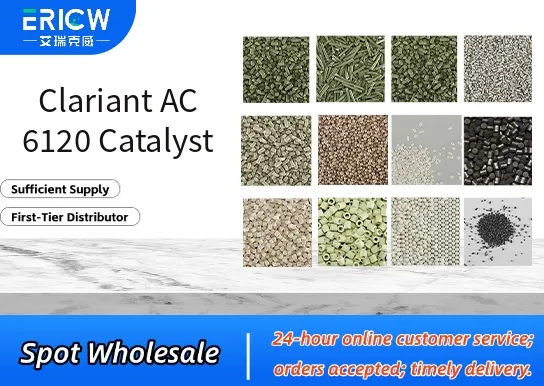
| Appearance | Black granules |
| Palladium Content | 5.0 ± 0.3 wt% |
| Particle Size Range | 1.2–2.5 mm |
| Bulk Density | ~450–500 g/L |
| Moisture Content | < 5.0 wt% |
| Primary Applications | Alkyne/alkadiene selective hydrogenation |
Q1: What is the primary function of Clariant AC 6120 Catalyst in polymer processing?
A: Clariant AC 6120 Catalyst is designed to accelerate crosslinking and curing reactions in thermosetting resins and reactive polymer systems, supporting improved throughput and enhanced final material properties such as thermal stability and mechanical strength.
Q2: Is AC 6120 compatible with common epoxy or phenolic resin systems?
A: Yes, AC 6120 demonstrates broad compatibility with epoxy, phenolic, and certain polyurethane-based formulations. Its performance should be verified under actual processing conditions due to formulation-specific interactions.
Q3: How is AC 6120 typically incorporated into a production batch?
A: It is generally added during the liquid-phase mixing stage, either directly or pre-dispersed in a carrier solvent or resin component. Homogeneous distribution is critical, and dosage depends on formulation requirements—typically used at low concentrations to achieve target cure kinetics.
Q4: Does AC 6120 require special handling or storage conditions?
A: Yes. Store in original sealed containers under cool, dry conditions away from moisture, strong oxidizing agents, and direct sunlight. Avoid prolonged exposure to ambient humidity to maintain catalytic activity and shelf life.
Contact With Us:
E-mail: wangxingqiang@ericwchem.com
Have a Questions? Call Us:
Add:
Building A1, Jiete Industrial Park, Huangpu District, Guangzhou City, Guangdong Province, China