English
 Español
 tiếng việt
 русский
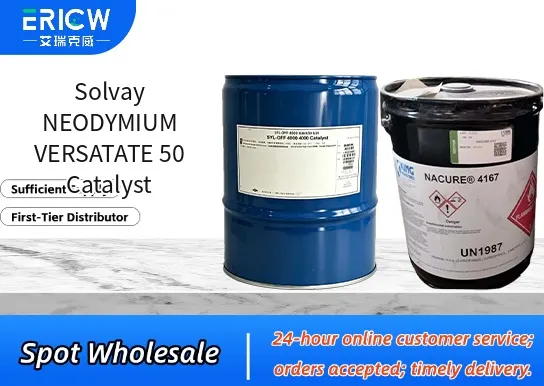
Highly active neodymium-based catalyst optimized for stereospecific diene polymerization.
Excellent solubility in common hydrocarbon solvents (e.g., hexane, cyclohexane, toluene).
Thermally stable formulation enabling consistent performance across industrial-scale reaction temperatures.
Precisely controlled metal content (50 wt% Nd) ensures reproducible catalytic activity and polymer microstructure.
Low volatility and non-hygroscopic nature support safe handling and long-term storage stability.
Stereoregular cis-1,4-polybutadiene (Nd-PBR) production for high-performance tires.
Copolymerization of butadiene and isoprene in solution-process synthetic rubber manufacturing.
High-cis polyisoprene synthesis for medical-grade elastomers and specialty adhesives.
Production of low-volatile, high-molecular-weight diene elastomers meeting automotive OEM specifications.
| Chemical Type | Neodymium carboxylate complex (versatate ligand) |
| Product Form | Liquid concentrate |
| Appearance | Clear, amber to reddish-brown viscous liquid |
| Neodymium Content | ~50 wt% (as Nd metal) |
| Solvent Base | Aromatic hydrocarbon (e.g., xylene/toluene blend) |
| Density (20 °C) | 1.08–1.12 g/cm³ |
| Flash Point (Closed Cup) | ≥65 °C |
| Storage Stability | ≥24 months under inert atmosphere at 5–30 °C |
Q1: What is the primary function of Solvay NEODYMIUM VERSATATE 50 in synthetic rubber production?
A: It serves as a highly active neodymium-based catalyst for the stereospecific polymerization of diene monomers—particularly in the production of high-cis polybutadiene (BR) and neodymium-based polyisoprene (Nd-IR)—enabling superior molecular weight control, narrow molecular weight distribution, and excellent elastomeric properties.
Q2: How is Solvay NEODYMIUM VERSATATE 50 typically supplied and handled?
A: It is supplied as a stable, viscous 50% w/w solution in a refined hydrocarbon solvent, designed for safe handling under inert atmosphere conditions. The formulation minimizes dust generation and improves metering accuracy compared to solid or highly concentrated alternatives.
Q3: What are the key advantages of using this catalyst over traditional neodymium oxide or chloride systems?
A: Solvay NEODYMIUM VERSATATE 50 offers improved solubility and dispersion in hydrocarbon-based polymerization media, faster initiation kinetics, enhanced batch-to-batch consistency, and reduced risk of reactor fouling—contributing to more robust and scalable industrial processes.
Q4: Is Solvay NEODYMIUM VERSATATE 50 compatible with common co-catalysts used in Nd-catalyzed diene polymerization?
A: Yes—it is specifically formulated to work synergistically with standard alkylaluminum co-catalysts (e.g., triethylaluminum, diethylaluminum chloride) and selectivity enhancers such as alkyl chlorides or alcohols, enabling fine-tuned control over microstructure and polymerization rate.
Q5: What storage conditions are recommended to maintain product stability?
A: Store in tightly sealed containers under dry, inert atmosphere (e.g., nitrogen or argon), at temperatures between 10 °C and 30 °C. Avoid prolonged exposure to moisture, air, or elevated temperatures, which may lead to viscosity increase or catalytic activity loss over time.
Contact With Us:
E-mail: wangxingqiang@ericwchem.com
Have a Questions? Call Us:
Add:
Building A1, Jiete Industrial Park, Huangpu District, Guangzhou City, Guangdong Province, China