English
 Español
 tiếng việt
 русский
Highly selective for hydrogenation of nitroaromatics to corresponding anilines under mild conditions.
Exceptional thermal and chemical stability in continuous fixed-bed operation.
Low metal leaching (<0.1 ppm Ni/Co) ensuring product purity and extended catalyst life.
Tailored pore structure for improved mass transfer and reduced coking tendency.
Available in multiple formulations optimized for varying feedstock impurity profiles.
Production of aromatic amines for agrochemical intermediates.
Synthesis of high-purity anilines used in polyurethane precursor manufacturing.
Hydrogenation of nitrobenzene derivatives in fine chemical synthesis.
Catalytic reduction in pharmaceutical API manufacturing processes.
Continuous-flow hydrogenation in green chemistry process intensification.
| Chemical Type | Nickel- or cobalt-based supported heterogeneous catalyst |
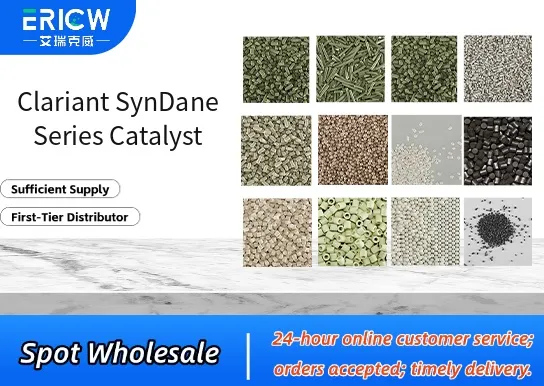
| Product Form | Extrudates (cylindrical pellets, 1.5–3.0 mm diameter) |
| Appearance | Gray to dark gray free-flowing granules |
| Primary Applications | Selective hydrogenation of nitroaromatics, reductive amination |
| Key Features | High activity at 80–150 °C, H₂ pressure 5–30 bar |
| Benefits | Reduced energy consumption, lower waste generation, improved EHS profile vs. stoichiometric reductions |
| Storage Conditions | Store under inert atmosphere; protect from moisture and air |
| Handling Precautions | Use in well-ventilated area; avoid dust formation; pyrophoric when dry |
Q1: What is the primary application of the SynDane Series catalysts?
A: The SynDane Series catalysts are specifically engineered for polyurethane (PU) systems, particularly in flexible and rigid foam manufacturing, where they promote efficient urethane formation and controlled reactivity profiles to support process stability and foam structure development.
Q2: How do SynDane catalysts differ from traditional amine or tin-based alternatives?
A: SynDane catalysts are metal-free, non-volatile, and designed to offer improved hydrolytic stability and reduced odor compared to many conventional amines. Unlike tin catalysts, they avoid regulatory and handling concerns associated with heavy metals while delivering balanced gelling and blowing activity in PU formulations.
Q3: What is the typical dosage range for SynDane catalysts in PU foam formulations?
A: Dosage depends on the specific formulation, desired reactivity profile, and processing conditions, but SynDane catalysts are typically used at low concentrations—generally ranging from 0.1% to 2% by weight relative to the polyol component.
Q4: Are SynDane catalysts compatible with water-blown and low-GWP blowing agent systems?
A: Yes, SynDane catalysts demonstrate broad compatibility with modern blowing systems—including water, hydrocarbons, and various low-global-warming-potential (low-GWP) physical blowing agents—supporting consistent foam rise, cell structure, and cure performance across evolving environmental requirements.
Q5: How should SynDane catalysts be stored and handled to maintain performance?
A: Store in tightly sealed original containers under cool, dry conditions away from direct sunlight and strong oxidizing agents. Avoid prolonged exposure to moisture or elevated temperatures, as these may affect long-term catalytic activity and shelf life.
Contact With Us:
E-mail: wangxingqiang@ericwchem.com
Have a Questions? Call Us:
Add:
Building A1, Jiete Industrial Park, Huangpu District, Guangzhou City, Guangdong Province, China