English
 Español
 tiếng việt
 русский
Highly selective for linear alpha olefin (LAO) production via ethylene oligomerization.
Thermally stable under continuous industrial operating conditions up to 120 °C.
Low catalyst residue carryover, minimizing downstream purification requirements.
Tailored pore structure enabling improved mass transfer and reduced fouling.
Compatible with conventional slurry-phase and fixed-bed reactor configurations.
Production of C₄–C₁₀ linear alpha olefins for plasticizer alcohols.
Synthesis of detergent-range LAOs (C₁₂–C₁₈) for biodegradable surfactants.
Co-monomer manufacturing for LLDPE and HDPE resins.
Feedstock preparation for alkylbenzenes and synthetic lubricants.
| Chemical Type | Nickel-based heterogeneous oligomerization catalyst |
| Product Form | Free-flowing granular solid |
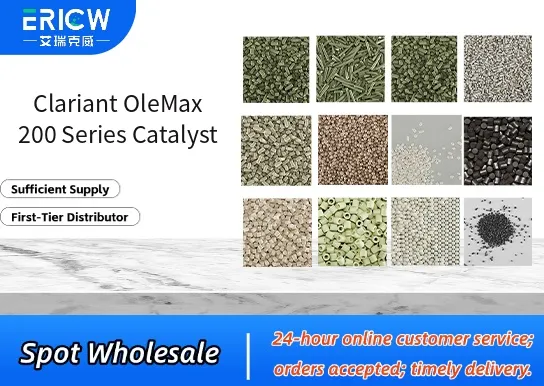
| Appearance | Gray to dark gray cylindrical pellets |
| Primary Applications | Ethylene oligomerization to linear alpha olefins (LAOs) |
| Key Features | High selectivity, low heavy-end formation, excellent attrition resistance |
| Benefits | Extended cycle life, reduced catalyst consumption, simplified product separation |
| Storage Conditions | Store under inert atmosphere (N₂); protect from moisture and air |
Q1: What is the primary function of the OleMax 200 Series in olefin polymerization processes?
A: The OleMax 200 Series is a high-activity Ziegler–Natta catalyst system designed to enable efficient propylene and ethylene–propylene copolymerization, offering excellent stereoselectivity and broad molecular weight distribution control under industrial slurry or bulk process conditions.
Q2: How does OleMax 200 differ from earlier-generation Clariant polyolefin catalysts?
A: Compared to prior generations, OleMax 200 features an optimized internal donor system and tailored support morphology, resulting in improved catalyst productivity, enhanced isotacticity control for polypropylene, and greater compatibility with modern external donors—enabling more flexible process operation and broader resin property tuning.
Q3: Is OleMax 200 suitable for use in gas-phase polymerization reactors?
A: Yes, OleMax 200 is engineered for robust performance in both slurry (bulk) and gas-phase polyolefin processes. Its particle morphology and thermal stability support consistent fluidization behavior and low fines generation under typical gas-phase operating conditions.
Q4: What are the recommended handling and storage conditions for OleMax 200 catalysts?
A: OleMax 200 should be stored under inert atmosphere (e.g., nitrogen or argon) at room temperature in sealed, moisture-resistant containers. Exposure to air, moisture, or elevated temperatures must be avoided to preserve catalytic activity and prevent premature deactivation.
Q5: Can OleMax 200 be used with common external donors such as alkoxysilanes or diethers?
A: Yes, OleMax 200 is fully compatible with a range of commercially available external donors—including cyclohexylmethyldimethoxysilane (CMDS), dicyclopentyldimethoxysilane (DCPDS), and diether-type donors—allowing processors to fine-tune tacticity, molecular weight, and hydrogen response according to target resin specifications.
Contact With Us:
E-mail: wangxingqiang@ericwchem.com
Have a Questions? Call Us:
Add:
Building A1, Jiete Industrial Park, Huangpu District, Guangzhou City, Guangdong Province, China