English
 Español
 tiếng việt
 русский
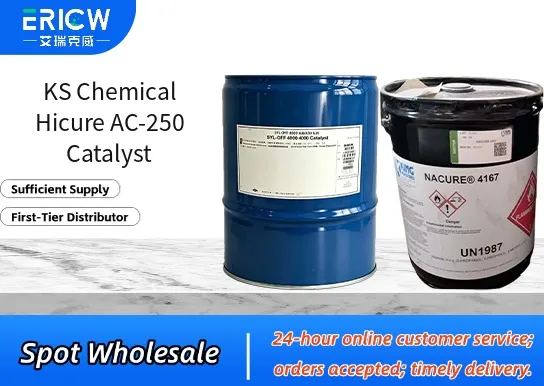
Highly selective for ambient-cure epoxy-amine reactions, minimizing side products and improving final resin clarity.
Low volatility and non-corrosive formulation, enhancing workplace safety and compatibility with standard processing equipment.
Thermally stable up to 180 °C, enabling reliable performance in both room-temperature and moderate-bake curing processes.
Water-tolerant design maintains catalytic activity in formulations with trace moisture content.
Easy dispersion in epoxy resins without pre-dissolution, supporting efficient high-shear mixing and scalable production.
Electronics encapsulation and potting compounds requiring low exotherm and long working life.
Industrial maintenance coatings and corrosion-resistant linings for steel infrastructure.
Adhesives and structural bonding systems in automotive and rail assembly.
Wind turbine blade composite tooling and infusion resins demanding precise gel-time control.
3D printing photopolymer-compatible hybrid epoxy formulations with dual-cure capability.
| Chemical Type | Latent amine-based accelerator |
| Product Form | Powder |
| Appearance | Free-flowing white to off-white granular powder |
| Primary Applications | Ambient- and heat-assisted epoxy-amine curing |
| Key Features | Latent, moisture-tolerant, non-yellowing |
| Recommended Loading Range | 1.0–3.0 wt% relative to epoxy resin |
| Storage Conditions | Store in original sealed container at 5–25 °C, protect from humidity |
| Shelf Life | 24 months under recommended storage conditions |
Q1: What is the primary function of Hicure AC-250 in thermoset resin systems?
A: Hicure AC-250 is a latent amine-based catalyst designed to promote efficient and controlled curing of epoxy, phenolic, and certain polyurethane systems—especially where extended pot life at ambient temperature and rapid crosslinking upon thermal activation are required.
Q2: How should Hicure AC-250 be incorporated into a formulation?
A: It is typically added during the final mixing stage under low-shear conditions. Pre-dispersion in a compatible liquid resin or solvent may improve homogeneity. Avoid prolonged exposure to moisture or acidic components prior to curing.
Q3: Is Hicure AC-250 compatible with common fillers and additives used in industrial composites?
A: Yes—it demonstrates good compatibility with silica, alumina trihydrate, glass fibers, and most conventional plasticizers and flame retardants. However, compatibility testing is recommended when using highly reactive modifiers or acidic pigments.
Q4: What storage conditions are recommended to maintain product stability?
A: Store in original sealed containers at temperatures between 5°C and 25°C, in a dry, well-ventilated area away from direct sunlight and strong oxidizing agents. Prolonged exposure to humidity or elevated temperatures may reduce latency performance.
Contact With Us:
E-mail: wangxingqiang@ericwchem.com
Have a Questions? Call Us:
Add:
Building A1, Jiete Industrial Park, Huangpu District, Guangzhou City, Guangdong Province, China