English
 Español
 tiếng việt
 русский
Broad-spectrum fungicidal activity against key industrial fungi, including Aspergillus, Penicillium, and Cladosporium species.
Stable performance across a wide pH range (4–10) and compatible with common water-based formulations and polymer systems.
Low volatility and non-volatile residue profile, supporting safe handling and long-term efficacy in enclosed environments.
Effective at low use concentrations (typically 0.05–0.2% w/w), enabling cost-efficient preservation without compromising material integrity.
Non-oxidizing chemistry that minimizes corrosion risk to metals and compatibility issues with elastomers and plastics.
Preservation of water-based paints, coatings, and architectural finishes.
Protection of adhesives, sealants, and caulks during storage and service life.
Anti-fungal treatment for construction materials such as gypsum board joint compounds and plasters.
Stabilization of industrial process waters and recirculating cooling systems prone to microbial fouling.
Protection of paper and paperboard products against mold growth in humid storage conditions.
| Chemical Type | Organosulfur compound (active ingredient: 2-(Thiocyanomethylthio)benzothiazole) |
| Product Form | Free-flowing granular solid |
| Appearance | Off-white to light tan granules |
| Active Ingredient Content | ≥ 50.0% w/w |
| Solubility in Water | Low (≈ 0.1 g/L at 20°C) |
| pH (1% aqueous suspension) | 6.5 – 7.5 |
| Storage Stability | ≥ 24 months at ≤ 30°C in original unopened packaging |
| Primary Applications | Industrial preservative for water-based polymers, coatings, and building materials |
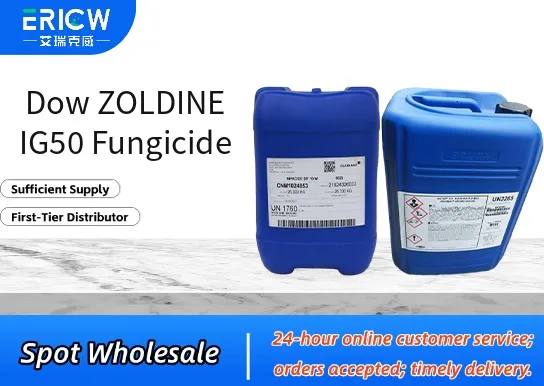
Q1: What is the primary active ingredient in Dow ZOLDINE IG50 Fungicide?
A: Dow ZOLDINE IG50 Fungicide is a proprietary iodine-based biocide formulation developed by Dow. It does not contain a single isolated active ingredient but relies on stabilized molecular iodine chemistry for broad-spectrum antifungal and antimicrobial activity.
Q2: In which types of industrial systems is ZOLDINE IG50 most commonly applied?
A: ZOLDINE IG50 is widely used in water-based industrial process fluids—particularly in metalworking fluids, latex emulsions, adhesives, and waterborne coatings—where sustained protection against fungal spoilage and microbial degradation is required during storage and use.
Q3: How does ZOLDINE IG50 compare to traditional isothiazolinone or formaldehyde-releasing biocides in terms of stability and compatibility?
A: ZOLDINE IG50 offers enhanced oxidative stability and reduced volatility compared to many conventional biocides. It demonstrates good compatibility with anionic, nonionic, and some cationic surfactants, as well as common thickeners and pH buffers—though compatibility testing under actual formulation conditions is always recommended.
Q4: What is the typical dosage range for effective fungal control in industrial formulations?
A: Effective dosage varies depending on system composition, microbial challenge, and regulatory requirements, but ZOLDINE IG50 is typically used at low concentrations—generally ranging from 0.1% to 2% by weight—based on total formulation mass. Optimal performance is best determined through laboratory efficacy testing and real-time monitoring.
Contact With Us:
E-mail: wangxingqiang@ericwchem.com
Have a Questions? Call Us:
Add:
Building A1, Jiete Industrial Park, Huangpu District, Guangzhou City, Guangdong Province, China