English
 Español
 tiếng việt
 русский
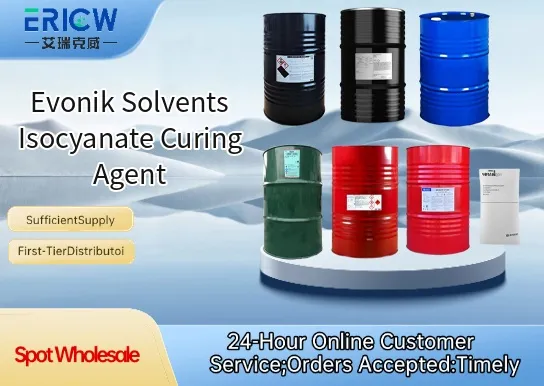
High reactivity with hydroxyl-functional resins for rapid cure development.
Excellent compatibility with aliphatic and aromatic polyol systems.
Low viscosity enables easy handling and homogeneous mixing without solvents.
Enhanced weather resistance and UV stability in final cured coatings.
Consistent batch-to-batch performance supported by Evonik’s stringent quality control.
Automotive OEM and refinish clearcoats.
Industrial maintenance coatings for metal and concrete substrates.
High-performance wood finishes requiring hardness and chemical resistance.
Plastic coatings for automotive interior and exterior trim parts.
Two-component (2K) polyurethane adhesives and sealants.
| Chemical Type | Aliphatic polyisocyanate (hexamethylene diisocyanate trimer, HDI-based) |
| Product Form | Liquid |
| Appearance | Clear, colorless to pale yellow liquid |
| NCO Content (wt%) | 19.5–20.5 |
| Viscosity at 25°C (mPa·s) | 800–1,200 |
| Specific Gravity (20°C) | 1.18–1.22 |
| Flash Point (°C, closed cup) | 145–155 |
| Storage Stability | 12 months under dry, cool conditions (≤25°C), sealed container |
Q1: What types of resin systems is this curing agent compatible with?
A: This isocyanate-based curing agent is specifically designed for use with hydroxyl-functional resins, including polyester, acrylic, and polyether polyols. It enables robust crosslinking in solvent-borne and high-solids coatings, adhesives, and sealants.
Q2: How does it compare to traditional aromatic isocyanates in terms of yellowing and weather resistance?
A: As an aliphatic isocyanate derivative, it offers significantly improved UV stability and resistance to yellowing compared to aromatic alternatives, making it suitable for applications where long-term gloss retention and color stability are critical.
Q3: What are the recommended handling and storage conditions?
A: Store in tightly sealed containers under dry, inert atmosphere (e.g., nitrogen blanket) at temperatures between 10–30 °C. Protect from moisture, heat, and direct sunlight. Always follow Evonik’s Safety Data Sheet for safe handling procedures and personal protective equipment requirements.
Q4: Can it be used in low-VOC or high-solids formulations?
A: Yes — its reactivity profile and compatibility with common industrial solvents support formulation flexibility, enabling effective use in both low-VOC and high-solids coating systems without compromising cure performance or film integrity.
Q5: What is the typical dosage range in a two-component system?
A: Dosage depends on the hydroxyl value and molecular weight of the resin component, but it is generally used at low concentrations — typically ranging from 0.1% to 2% by weight relative to total solids — to achieve full crosslink density while maintaining pot life and application properties.
Contact With Us:
E-mail: wangxingqiang@ericwchem.com
Have a Questions? Call Us:
Add:
Building A1, Jiete Industrial Park, Huangpu District, Guangzhou City, Guangdong Province, China