English
 Español
 tiếng việt
 русский
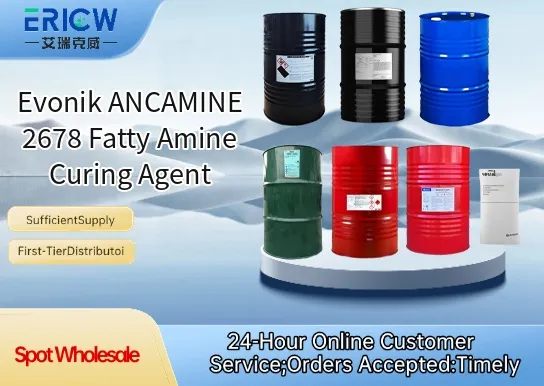
Low-viscosity liquid enabling easy handling and homogeneous mixing with epoxy resins.
Excellent compatibility with standard bisphenol-A and bisphenol-F epoxy systems.
Provides good flexibility and impact resistance in cured epoxy networks.
Offers reduced volatility and lower skin sensitization potential compared to conventional aliphatic amines.
Enables ambient-temperature curing with balanced pot life and rapid development of initial mechanical properties.
Industrial flooring and protective coatings requiring chemical resistance and durability.
Concrete repair mortars and anchoring grouts for construction and infrastructure.
Electrical encapsulation and insulating compounds for medium-voltage applications.
Adhesives and structural bonding systems in transportation and wind energy sectors.
Marine and offshore coating systems where moisture tolerance and adhesion to damp substrates are critical.
| Chemical Type | Fatty amine-based polyamine adduct |
| Product Form | Liquid |
| Appearance | Pale yellow to amber, clear liquid |
| Primary Applications | Epoxy resin curing agent for coatings, adhesives, and composites |
| Key Features | Low viscosity, ambient-cure capability, low volatility, good flexibility |
| Benefits | Improved worker safety profile, enhanced substrate wetting, extended working time vs. DETA |
| Storage Stability | Stable under dry, cool conditions (≤30 °C); protect from moisture and strong oxidizers |
| Handling Precautions | Use appropriate PPE; avoid skin contact and inhalation of mists/vapors |
Q1: What is the primary function of ANCAMINE 2678 in epoxy systems?
A: ANCAMINE 2678 is a fatty amine-based curing agent designed to react with epoxy resins, enabling crosslinking at ambient or slightly elevated temperatures. It delivers good flexibility, chemical resistance, and low exotherm during cure—making it suitable for coatings, adhesives, and composite applications where toughness and handling safety are important.
Q2: How does ANCAMINE 2678 compare to conventional aliphatic amines in terms of reactivity and pot life?
A: Due to its fatty chain structure, ANCAMINE 2678 exhibits lower reactivity than highly reactive aliphatic diamines (e.g., DETA or TETA), resulting in extended pot life and improved formulation stability. This allows for greater processing flexibility in industrial coating and casting operations without sacrificing final mechanical performance.
Q3: Is ANCAMINE 2678 compatible with standard epoxy resins such as DGEBA?
A: Yes, ANCAMINE 2678 is broadly compatible with liquid and solid bisphenol-A and bisphenol-F epoxy resins, including standard DGEBA types. Compatibility and optimal stoichiometry should be confirmed experimentally based on resin functionality and desired cure profile, but typical usage levels fall within the low-to-moderate range relative to epoxy equivalents.
Q4: What are key handling and safety considerations when working with this curing agent?
A: As with most amine curing agents, ANCAMINE 2678 is alkaline and may cause skin and eye irritation. Appropriate personal protective equipment—including nitrile gloves, safety goggles, and adequate ventilation—is recommended during handling and mixing. Avoid prolonged or repeated skin contact, and refer to the Safety Data Sheet (SDS) for detailed toxicological and first-aid information.
Contact With Us:
E-mail: wangxingqiang@ericwchem.com
Have a Questions? Call Us:
Add:
Building A1, Jiete Industrial Park, Huangpu District, Guangzhou City, Guangdong Province, China