English
 Español
 tiếng việt
 русский
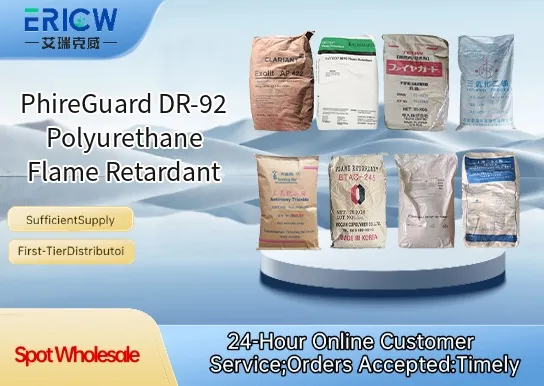
Halogen-free formulation ensures low smoke density and reduced toxic gas emission during combustion.
Excellent compatibility with flexible and rigid polyurethane foams without compromising mechanical properties.
Efficient char-forming mechanism enhances flame resistance while maintaining foam cell structure integrity.
Thermally stable up to 220 °C, enabling seamless integration into standard PU processing conditions.
Non-migrating design prevents bloom or leaching over time, ensuring long-term fire performance retention.
Furniture cushioning foams for residential and contract seating (e.g., sofas, office chairs).
Automotive interior foams including seat cores, headrests, and armrests meeting FMVSS 302 requirements.
Building insulation panels and spray-applied PU foams in commercial construction.
Marine upholstery and bedding systems requiring UL 1100 or IMO FTP Code compliance.
Transportation seating for rail and bus interiors adhering to EN 45545-2 R22/R23 standards.
| Chemical Type | Organophosphorus-based flame retardant |
| Product Form | Free-flowing white to off-white granular solid |
| Appearance | Uniform granules, no visible dust or clumps |
| Primary Applications | Flexible & rigid polyurethane foams |
| Key Features | Halogen-free, non-migrating, thermally stable |
| Recommended Loading Range | 12–18 wt% in polyol component |
| Density (25 °C) | 1.45–1.55 g/cm³ |
| Storage Stability | 24 months in original sealed packaging at <25 °C and <60% RH |
Q1: What types of polyurethane systems is PhireGuard DR-92 compatible with?
A: PhireGuard DR-92 is formulated for use in both flexible and rigid polyurethane foams, including slabstock, molded, and spray-applied systems. It demonstrates good compatibility with common polyol blends and isothiocyanate-based isocyanates, supporting stable processing and uniform dispersion without significant impact on foam morphology.
Q2: How does PhireGuard DR-92 achieve flame retardancy in PU foams?
A: PhireGuard DR-92 operates primarily through a condensed-phase mechanism, promoting char formation during thermal decomposition. This char layer acts as a physical barrier that reduces heat transfer and limits the release of flammable volatiles, thereby improving ignition resistance and slowing flame spread in polyurethane matrices.
Q3: Is PhireGuard DR-92 suitable for low-emission or indoor air quality–sensitive applications?
A: Yes — PhireGuard DR-92 is designed to minimize volatile organic compound (VOC) emissions and has demonstrated low odor profile in standard foam formulations. It supports compliance with common indoor air quality guidelines when used within recommended dosage ranges and processed under controlled conditions.
Q4: What is the typical dosage range for effective flame retardancy?
A: Effective performance is generally achieved at low concentrations, typically ranging from 0.1% to 2% by weight relative to total formulation mass. Optimal dosage depends on foam density, isocyanate index, desired fire performance level, and regulatory classification requirements.
Contact With Us:
E-mail: wangxingqiang@ericwchem.com
Have a Questions? Call Us:
Add:
Building A1, Jiete Industrial Park, Huangpu District, Guangzhou City, Guangdong Province, China