English
 Español
 tiếng việt
 русский
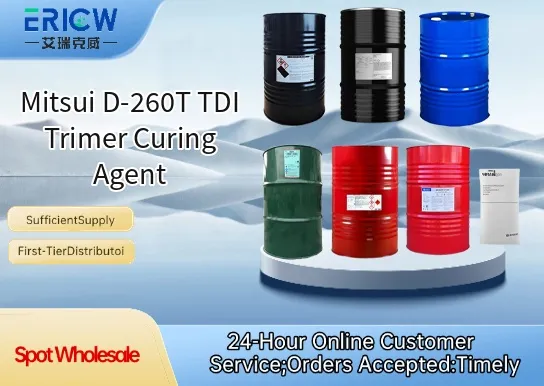
Low-viscosity liquid trimer offering excellent flow and leveling in coating and adhesive formulations.
High functionality with controlled NCO content for balanced reactivity and extended pot life.
Enhanced weather resistance and UV stability compared to conventional TDI-based curing agents.
Compatible with a wide range of hydroxyl-functional resins including polyesters, acrylics, and polyethers.
Meets stringent VOC regulations due to absence of monomeric TDI and low volatility profile.
Automotive OEM clearcoats and topcoats requiring high gloss and durability.
Industrial maintenance coatings for metal and concrete substrates.
High-performance wood finishes in furniture and flooring applications.
Two-component polyurethane adhesives for laminated packaging and composite bonding.
Electrical insulation varnishes and coil coatings demanding thermal and chemical resistance.
| Chemical Type | TDI-based isocyanurate trimer |
| Product Form | Clear, light-yellow liquid |
| Appearance | Homogeneous, transparent liquid without sediment |
| NCO Content (wt%) | 13.5 – 14.5% |
| Viscosity (mPa·s, 25°C) | 800 – 1,200 |
| Specific Gravity (25°C) | 1.20 – 1.24 |
| Storage Stability | ≥12 months at 25°C in sealed container |
| Primary Applications | 2K PU coatings, adhesives, and elastomers |
Q1: What is the primary function of Mitsui D-260T in polyurethane systems?
A: Mitsui D-260T is a trifunctional aromatic isocyanurate-based curing agent derived from toluene diisocyanate (TDI). It functions as a crosslinker for hydroxyl-terminated resins—such as polyesters, polyethers, and acrylic polyols—to form thermoset polyurethane coatings, adhesives, and elastomers with enhanced chemical resistance, hardness, and thermal stability.
Q2: How does D-260T compare to aliphatic isocyanurate curing agents in terms of performance and handling?
A: As an aromatic trimer, D-260T offers higher reactivity and superior mechanical/chemical resistance compared to many aliphatic alternatives, but it is not UV-stable and may yellow upon exposure to light. It also exhibits lower viscosity than many hexamethylene diisocyanate (HDI)-based trimers, facilitating easier formulation and mixing without excessive solvent dilution.
Q3: Is D-260T suitable for ambient-cure or low-bake applications?
A: Yes—D-260T is reactive enough to support ambient-cure formulations when paired with appropriate catalysts (e.g., tertiary amines or tin compounds), and it is also widely used in forced-dry or low-bake (typically 80–130 °C) industrial coating systems where rapid through-cure and high crosslink density are required.
Q4: What are key storage and handling considerations for D-260T?
A: Store in tightly sealed containers under dry, cool conditions (preferably below 30 °C) and protect from moisture, as isocyanates react readily with water. Avoid prolonged exposure to humidity during handling; use inert gas blanketing if storage exceeds several weeks. Always follow standard industrial hygiene practices for aromatic isocyanates—including adequate ventilation and personal protective equipment.
Contact With Us:
E-mail: wangxingqiang@ericwchem.com
Have a Questions? Call Us:
Add:
Building A1, Jiete Industrial Park, Huangpu District, Guangzhou City, Guangdong Province, China