English
 Español
 tiếng việt
 русский
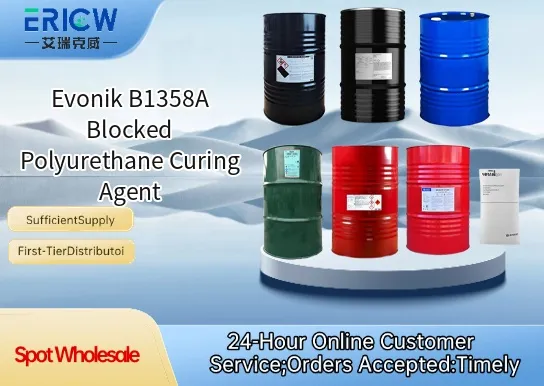
Highly stable blocked isocyanate chemistry enabling extended pot life at ambient temperature.
Controlled de-blocking activation at 120–140 °C, ensuring reliable crosslinking without premature reaction.
Excellent compatibility with hydroxyl-functional acrylics, polyesters, and alkyd resins.
Low VOC emission profile, supporting compliance with stringent environmental regulations.
Delivers superior hardness, chemical resistance, and gloss retention in cured coatings.
Automotive OEM and refinish clearcoats.
Industrial coil and can coatings.
Wood furniture and flooring finishes.
Plastic coatings for automotive interior parts.
General-purpose high-performance industrial topcoats.
| Chemical Type | Blocked aliphatic polyisocyanate (hexamethylene diisocyanate derivative) |
| Product Form | Liquid |
| Appearance | Clear, pale yellow liquid |
| Primary Applications | Two-component (2K) polyurethane coating systems requiring thermal curing |
| Key Features | Blocked NCO functionality, low free monomer content, high storage stability |
| Benefits | Improved handling safety, reduced odor, enhanced film formation and durability |
| Solubility | Compatible with common organic solvents (e.g., xylene, butyl acetate, PGDA) |
| Storage Conditions | Store below 30 °C, protect from moisture and direct sunlight |
Q1: What is the primary function of Evonik B1358A in polyurethane systems?
A: Evonik B1358A is a blocked aliphatic polyisocyanate curing agent designed to provide latent reactivity—remaining stable at ambient temperatures while enabling controlled crosslinking upon thermal activation, typically above 120 °C. It delivers excellent gloss retention, weather resistance, and mechanical performance in thermoset coatings and adhesives.
Q2: Which resin types is B1358A commonly compatible with?
A: B1358A is formulated for use with hydroxyl-functional resins, including polyester polyols, acrylic polyols, and polyether polyols. Compatibility should be verified experimentally, as performance depends on hydroxyl value, molecular weight, and formulation pH.
Q3: How does the blocking/deblocking behavior affect processing and storage?
A: The blocked structure ensures excellent pot life and shelf stability at room temperature, eliminating premature gelation during mixing or storage. Deblocking occurs only upon heating, allowing for extended processing windows and compatibility with one-component (1K) formulations.
Q4: Can B1358A be used in low-VOC or high-solids coating systems?
A: Yes—B1358A is suitable for solventborne, high-solids, and certain solvent-reduced systems due to its low volatility and absence of free isocyanate monomers. Formulators often select it when balancing reactivity control with regulatory and sustainability goals.
Q5: What are typical cure conditions for optimal film properties?
A: Full crosslinking generally requires thermal activation between 130 °C and 160 °C for 10–30 minutes, depending on substrate, film thickness, and oven profile. Lower temperatures may be feasible with extended dwell times, though full property development is best achieved within the recommended range.
Contact With Us:
E-mail: wangxingqiang@ericwchem.com
Have a Questions? Call Us:
Add:
Building A1, Jiete Industrial Park, Huangpu District, Guangzhou City, Guangdong Province, China