English
 Español
 tiếng việt
 русский
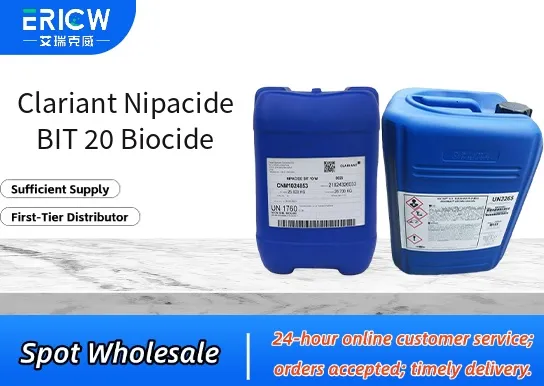
Broad-spectrum efficacy against bacteria, fungi, and algae in aqueous systems.
Stable over a wide pH range (pH 2–12), ensuring compatibility with diverse formulations.
Low volatility and minimal odor, supporting safer handling and improved workplace compliance.
Excellent compatibility with common surfactants, thickeners, and other water-based additives.
Non-oxidizing mode of action, reducing corrosion risk to metal components in process systems.
Preservation of water-based paints and coatings during storage and application.
Microbial control in industrial metalworking fluids and coolants.
Protection of adhesives, sealants, and construction chemicals against spoilage.
Stabilization of pigment dispersions and architectural coatings.
Maintenance of hygiene in non-ionic cleaning formulations and detergents.
| Chemical Type | 1,2-Benzisothiazolin-3-one (BIT) |
| Product Form | Aqueous solution |
| Appearance | Clear, pale yellow liquid |
| Active Content | 20.0 ± 1.0 wt% BIT |
| pH (1% aqueous solution) | 3.5 – 5.5 |
| Density (20 °C) | 1.08 – 1.12 g/cm³ |
| Solubility | Miscible with water and many polar organic solvents |
| Primary Applications | Pigment dispersions, latex paints, metalworking fluids, adhesives |
Q1: What is the primary active ingredient in Nipacide BIT 20?
A: The active biocidal component is 1,2-benzisothiazolin-3-one (BIT), formulated as a stable 20% aqueous solution with proprietary stabilizers to ensure compatibility and shelf life in industrial formulations.
Q2: In which types of formulations is Nipacide BIT 20 commonly used?
A: It is widely applied in water-based industrial products such as latex paints, adhesives, sealants, metalworking fluids, and construction chemicals—where broad-spectrum protection against bacteria, yeasts, and molds is required during storage and in-use conditions.
Q3: How does pH affect the performance and stability of Nipacide BIT 20?
A: Optimal biocidal activity and formulation stability are typically maintained within a pH range of 4–9. Outside this range, hydrolysis may accelerate, potentially reducing efficacy and shelf life—so pH monitoring and adjustment are recommended during incorporation.
Q4: Is Nipacide BIT 20 compatible with common thickeners and surfactants?
A: Yes, it demonstrates good compatibility with associative and non-associative thickeners (e.g., HASE, HEUR, cellulose derivatives) and most anionic, nonionic, and amphoteric surfactants—though compatibility testing under actual formulation conditions is always advised.
Q5: What is the typical dosage range for effective preservation?
A: Dosage depends on formulation complexity, raw material bioburden, and end-use requirements, but it is generally used at low concentrations—typically ranging from 0.1% to 2% by weight of the final product—to achieve robust, long-term microbial control.
Contact With Us:
E-mail: wangxingqiang@ericwchem.com
Have a Questions? Call Us:
Add:
Building A1, Jiete Industrial Park, Huangpu District, Guangzhou City, Guangdong Province, China