English
 Español
 tiếng việt
 русский
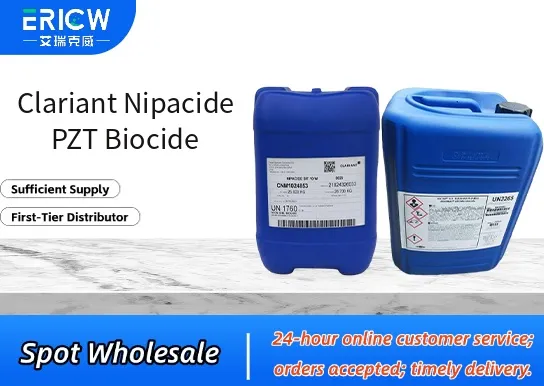
Highly effective broad-spectrum biocide against bacteria, fungi, and algae in water-based systems.
Stable across a wide pH range (pH 4–10), ensuring consistent performance in diverse process conditions.
Low odor and non-volatile formulation, enhancing workplace safety and operator acceptance.
Compatible with common industrial additives, including surfactants, thickeners, and corrosion inhibitors.
Non-oxidizing mode of action, minimizing corrosion risk to metal components and piping.
Preservation of water-based paints and coatings during storage and application.
Microbial control in pigment dispersions and colorant concentrates.
Protection of architectural and industrial latex emulsions against spoilage.
Stabilization of adhesives, sealants, and construction chemicals containing water.
Prevention of biofilm formation in recirculating cooling water sidestreams and process water loops.
| Chemical Type | Isothiazolinone-based biocide blend |
| Product Form | Clear, amber liquid |
| Appearance | Homogeneous free-flowing liquid |
| Primary Applications | Preservative for water-based industrial formulations |
| Key Features | Broad-spectrum efficacy, pH stability, low volatility |
| Benefits | Extended shelf life, reduced microbial spoilage, compatibility with polymer systems |
| Storage Conditions | Store in original container at 5–30°C, protect from freezing and direct sunlight |
Q1: What is the primary mode of action of Nipacide PZT Biocide?
A: Nipacide PZT Biocide functions primarily through the controlled release of zinc pyrithione, which disrupts microbial cell membrane integrity and inhibits key enzymatic processes essential for growth and survival of bacteria, fungi, and algae.
Q2: In which types of industrial formulations is Nipacide PZT typically used?
A: It is commonly incorporated into water-based coatings, adhesives, construction materials, and polymer emulsions where long-term protection against microbial spoilage during storage and in-service use is required.
Q3: Is Nipacide PZT compatible with common thickeners and surfactants used in aqueous systems?
A: Yes, it demonstrates good compatibility with a broad range of non-ionic and anionic surfactants, as well as associative and cellulosic thickeners—though compatibility testing under actual formulation conditions is recommended to ensure stability and efficacy.
Q4: How should Nipacide PZT be added to a formulation to ensure optimal performance?
A: It is generally added during the final stage of manufacturing, after pH adjustment and cooling, to minimize thermal degradation and maximize dispersion. Pre-dilution in water or a compatible solvent may improve uniform distribution.
Q5: Does Nipacide PZT provide protection against both gram-positive and gram-negative bacteria?
A: Yes, it exhibits broad-spectrum antimicrobial activity, including effective control of common gram-positive (e.g., Staphylococcus spp.) and gram-negative (e.g., Pseudomonas spp.) bacteria, as well as yeasts and molds.
Contact With Us:
E-mail: wangxingqiang@ericwchem.com
Have a Questions? Call Us:
Add:
Building A1, Jiete Industrial Park, Huangpu District, Guangzhou City, Guangdong Province, China