English
 Español
 tiếng việt
 русский
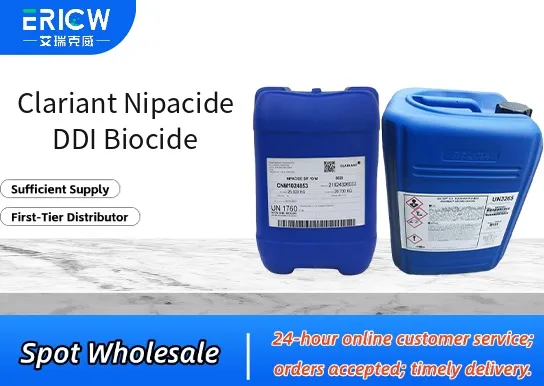
Broad-spectrum antimicrobial activity against bacteria, fungi, and algae.
Low-toxicity formulation suitable for industrial water systems with stringent environmental requirements.
Excellent thermal and hydrolytic stability under typical process conditions.
Compatible with common water treatment additives including corrosion inhibitors and dispersants.
Non-oxidizing mode of action helps prevent development of microbial resistance.
Cooling water systems in power generation and HVAC applications.
Process water circuits in paper & pulp manufacturing.
Recirculating water systems in metalworking fluid operations.
Industrial wastewater treatment and reuse systems.
Membrane-based water purification units requiring biofouling control.
| Chemical Type | DDI (1,2-benzisothiazolin-3-one) based biocide |
| Product Form | Liquid concentrate |
| Appearance | Clear, pale yellow to amber liquid |
| pH (1% aqueous solution) | 6.0 – 8.0 |
| Density (20 °C) | 1.05 – 1.10 g/cm³ |
| Solubility | Miscible with water and common polar solvents |
| Primary Applications | Non-oxidizing biocide for industrial water treatment |
| Key Features | Broad-spectrum, low-dose efficacy, stable in hard water |
Q1: What is the primary mode of action of Nipacide DDI Biocide?
A: Nipacide DDI Biocide functions primarily through membrane disruption and interference with essential cellular processes in microorganisms, delivering broad-spectrum efficacy against bacteria, yeasts, and molds.
Q2: In which types of industrial formulations is Nipacide DDI commonly used?
A: It is widely applied in water-based industrial products such as metalworking fluids, latex paints, adhesives, construction chemicals, and cleaning concentrates—particularly where long-term preservation and compatibility with anionic and nonionic systems are required.
Q3: Is Nipacide DDI compatible with common thickeners and surfactants?
A: Yes, Nipacide DDI demonstrates good compatibility with many standard rheology modifiers (e.g., associative and cellulosic thickeners) and both anionic and nonionic surfactants, though compatibility testing under actual formulation conditions is recommended.
Q4: How should Nipacide DDI be incorporated into a formulation?
A: It is typically added during the cool-down phase or post-emulsification stage to avoid thermal degradation, and can be dosed neat or pre-diluted in water or a compatible solvent—depending on formulation viscosity and mixing efficiency.
Contact With Us:
E-mail: wangxingqiang@ericwchem.com
Have a Questions? Call Us:
Add:
Building A1, Jiete Industrial Park, Huangpu District, Guangzhou City, Guangdong Province, China