English
 Español
 tiếng việt
 русский
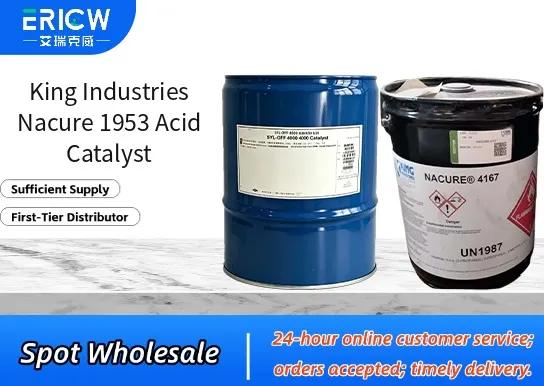
Highly effective low-temperature curing catalyst for amino-formaldehyde resins.
Offers excellent shelf stability in solvent-based and water-reducible systems.
Delivers balanced reactivity—fast cure onset without premature gelation.
Compatible with melamine-, urea-, and benzoguanamine-formaldehyde resin formulations.
Low volatility and minimal odor, supporting improved workplace safety and regulatory compliance.
Automotive coil coatings requiring rapid cure at moderate oven temperatures.
Industrial maintenance coatings for metal substrates including appliances and HVAC components.
Wood furniture and panel finishes based on melamine-modified alkyd or acrylic resins.
Can coating systems where film hardness and chemical resistance are critical.
General-purpose baked enamels for OEM and aftermarket metal finishing.
| Chemical Type | Sulfonic acid derivative (non-volatile, latent catalyst) |
| Product Form | Liquid |
| Appearance | Clear, light amber liquid |
| Primary Applications | Crosslinking catalyst for amino-formaldehyde resins |
| Key Features | Latent acidity, thermal activation, resin compatibility |
| Benefits | Improved pot life, reduced oven energy consumption, enhanced film integrity |
| Storage Conditions | Store in original container at 10–30°C; protect from moisture and freezing |
| Handling Precautions | Use appropriate PPE; avoid contact with skin and eyes; handle in well-ventilated areas |
Q1: What is the primary function of Nacure 1953 in coating and ink formulations?
A: Nacure 1953 is a liquid acid catalyst designed to accelerate thermoset reactions—particularly in urethane, melamine, and epoxy crosslinking systems—enabling faster cure at lower temperatures and improved film hardness and chemical resistance.
Q2: Is Nacure 1953 compatible with waterborne systems?
A: Yes, Nacure 1953 exhibits good compatibility with many waterborne acrylic, polyurethane, and hybrid dispersions, though formulation stability and hydrolytic sensitivity should be verified during development due to its acidic nature.
Q3: How should Nacure 1953 be incorporated into a formulation?
A: It is typically added during the let-down stage under moderate agitation, after neutralization of any alkaline components. Pre-dilution with a compatible solvent or resin solution may improve dispersion and reduce localized acidity effects.
Q4: Does Nacure 1953 require post-cure baking, or can it cure at ambient conditions?
A: While it enhances low-temperature thermal cure, Nacure 1953 is not a true ambient-cure catalyst on its own; effective crosslinking generally requires elevated temperature activation (e.g., 100–150 °C), depending on resin chemistry and film thickness.
Q5: What safety and handling precautions are recommended for Nacure 1953?
A: As an acidic material, it may cause skin and eye irritation. Users should wear appropriate PPE—including nitrile gloves, safety goggles, and ventilation—and consult the current Safety Data Sheet (SDS) before handling or scaling up use.
Contact With Us:
E-mail: wangxingqiang@ericwchem.com
Have a Questions? Call Us:
Add:
Building A1, Jiete Industrial Park, Huangpu District, Guangzhou City, Guangdong Province, China