English
 Español
 tiếng việt
 русский
Highly selective for low-temperature methanol synthesis under industrial pressure conditions.
Exceptional long-term stability and resistance to sintering and sulfur poisoning.
Optimized copper–zinc–alumina composition with proprietary structural promoters.
Reduced activation time and lower pre-reduction temperature versus conventional Cu/ZnO/Al₂O₃ catalysts.
Consistent performance across varying feed gas compositions, including CO₂-rich syngas streams.
Methanol production in large-scale single-train and multi-train ammonia–methanol integrated plants.
Renewable methanol synthesis from green hydrogen and captured CO₂.
Small-to-medium scale modular methanol units for distributed chemical manufacturing.
CO₂-to-methanol conversion in carbon capture and utilization (CCU) facilities.
Hybrid syngas upgrading where feed contains elevated CO₂ or fluctuating H₂/CO ratios.
| Chemical Type | Cu/ZnO/Al₂O₃-based heterogeneous catalyst with proprietary structural promoter |
| Product Form | Extruded cylindrical pellets (5 mm diameter × 5–10 mm length) |
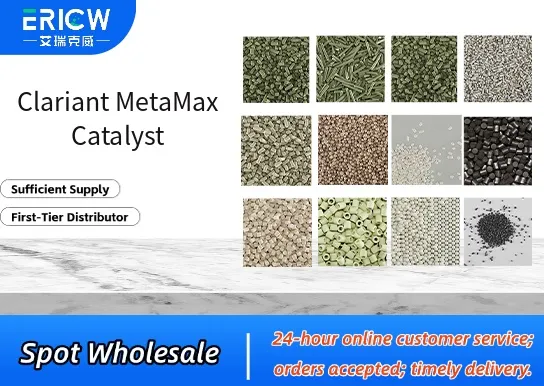
| Appearance | Grayish-black free-flowing granules |
| Primary Applications | Low-pressure, low-temperature catalytic synthesis of methanol from syngas |
| Key Features | Enhanced Cu surface area, optimized ZnO dispersion, thermally stable alumina matrix |
| Benefits | Higher single-pass conversion, extended catalyst life (>18,000 operating hours), reduced energy input per ton of methanol |
| Storage Requirement | Store in sealed containers under dry, inert atmosphere; avoid moisture and air exposure |
| Handling Precaution | Use appropriate PPE during loading; avoid dust generation; pyrophoric when freshly reduced |
Q1: What is the primary function of MetaMax Catalyst in polymer processing?
A: MetaMax Catalyst is a high-performance, metal-free catalytic system designed to accelerate crosslinking and curing reactions—particularly in peroxide-initiated thermoset systems such as silicone rubber, liquid silicone rubber (LSR), and certain elastomeric compounds. It enhances scorch safety, improves cure efficiency, and supports consistent network formation without introducing metallic residues.
Q2: Is MetaMax Catalyst compatible with food-contact or medical-grade silicone formulations?
A: Yes—MetaMax Catalyst is formulated to meet stringent purity requirements for sensitive applications. It contains no heavy metals or halogenated compounds, and its residue profile supports compliance with global food-contact and biocompatibility expectations when used within recommended processing conditions and dosage ranges.
Q3: How should MetaMax Catalyst be incorporated into a formulation?
A: It is typically added during the mixing stage—either directly to the base polymer or pre-dispersed in a carrier fluid or masterbatch—for uniform distribution. Dosage depends on formulation requirements and desired cure kinetics, but it is generally used at low concentrations relative to the total formulation weight.
Q4: Does MetaMax Catalyst affect the shelf life or storage stability of uncured compounds?
A: When properly formulated and stored under recommended conditions (cool, dry, and protected from moisture), MetaMax Catalyst contributes to improved scorch delay and extended processing window without compromising the ambient stability of uncured materials.
Contact With Us:
E-mail: wangxingqiang@ericwchem.com
Have a Questions? Call Us:
Add:
Building A1, Jiete Industrial Park, Huangpu District, Guangzhou City, Guangdong Province, China