English
 Español
 tiếng việt
 русский
Highly selective for linear alpha olefin (LAO) production via ethylene oligomerization.
Thermally stable under industrial fixed-bed or slurry-phase reactor conditions.
Low heavy-end formation, minimizing downstream separation burden and improving yield efficiency.
Tailored metal-support interaction for extended catalyst lifetime and consistent activity over multiple cycles.
Compatible with standard regeneration protocols used in continuous LAO manufacturing units.
Production of C4–C10 linear alpha olefins for plasticizer alcohols.
Synthesis of detergent-range olefins (C12–C14) for LAB (linear alkylbenzene) manufacturing.
Co-production of higher olefins (C16–C20) for synthetic lubricant base stocks.
On-purpose propylene and butylene co-feed enhancement in mixed-olefin oligomerization units.
| Chemical Type | Nickel-based heterogeneous catalyst with proprietary promoter system |
| Product Form | Free-flowing granular solid |
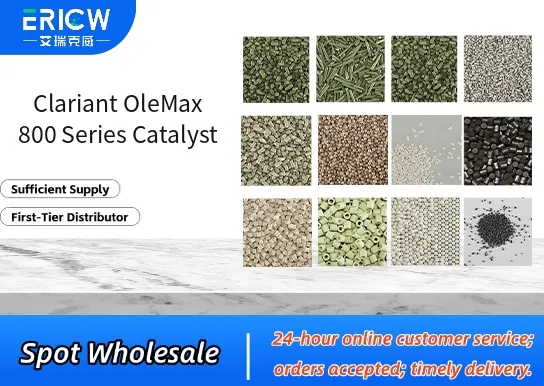
| Appearance | Gray to dark gray cylindrical pellets (1.5–2.5 mm diameter) |
| Primary Applications | Ethylene oligomerization to linear alpha olefins (LAOs) |
| Key Features | High selectivity to α-olefins, low isomerization, minimal dimerization byproducts |
| Benefits | Reduced energy consumption per ton of LAO, lower catalyst replacement frequency |
| Storage Conditions | Store under inert atmosphere (N₂ or Ar) at ambient temperature; protect from moisture |
Q1: What is the primary function of the OleMax 800 Series in olefin polymerization processes?
A: The OleMax 800 Series is a high-activity Ziegler–Natta catalyst system designed to enable efficient propylene and ethylene–propylene copolymerization, offering excellent stereoselectivity and broad molecular weight distribution control under industrial slurry or bulk process conditions.
Q2: How does OleMax 800 differ from earlier-generation Clariant polyolefin catalysts?
A: Compared to prior generations, OleMax 800 features an optimized internal donor system and tailored support morphology, resulting in improved catalyst productivity, enhanced isotacticity control for polypropylene, and greater tolerance to common process impurities such as chlorides and oxygenates.
Q3: Is OleMax 800 compatible with external electron donors commonly used in modern polypropylene plants?
A: Yes — OleMax 800 is specifically engineered for use with standard alkylalkoxy silane external donors (e.g., cyclohexylmethyldimethoxysilane or dicyclopentyldimethoxysilane), and its performance profile has been validated across multiple commercial donor combinations in both loop and gas-phase reactors.
Q4: What are typical handling and storage requirements for OleMax 800 catalysts?
A: OleMax 800 catalysts must be stored under inert atmosphere (nitrogen or argon) at temperatures between 0 °C and 25 °C, protected from moisture, air, and direct light. Handling requires strict adherence to glovebox or purged-system protocols due to their pyrophoric nature when exposed to ambient air.
Q5: Can OleMax 800 be used to produce impact copolymers or random copolymers?
A: Yes — OleMax 800 demonstrates proven versatility in producing both high-clarity random copolymers (with controlled ethylene incorporation) and heterophasic impact copolymers, supporting multi-reactor configurations where reactor staging and comonomer feed strategies are leveraged to tailor phase morphology.
Contact With Us:
E-mail: wangxingqiang@ericwchem.com
Have a Questions? Call Us:
Add:
Building A1, Jiete Industrial Park, Huangpu District, Guangzhou City, Guangdong Province, China