English
 Español
 tiếng việt
 русский
Highly selective methanol synthesis catalyst optimized for low-pressure, energy-efficient operation.
Robust thermal and mechanical stability under dynamic industrial process conditions.
Enhanced resistance to sintering and sulfur poisoning compared to conventional Cu/ZnO/Al₂O₃ formulations.
Consistent long-term activity with extended catalyst lifetime and reduced shutdown frequency.
Designed for seamless integration into existing low-pressure methanol synthesis loops without major retrofitting.
Low-pressure methanol production from syngas in modern single-train plants.
CO₂ hydrogenation processes for renewable methanol synthesis using captured carbon dioxide.
Small-to-medium scale modular methanol units targeting distributed chemical production.
Upgrading of syngas from biomass gasification or waste-to-energy sources.
| Chemical Type | Cu/ZnO/Al₂O₃-based heterogeneous catalyst |
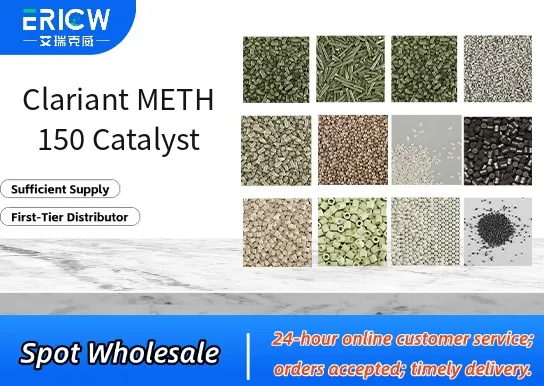
| Product Form | Cylindrical extrudates (5 mm diameter × 5–10 mm length) |
| Appearance | Grey to dark grey solid pellets |
| Primary Applications | Methanol synthesis from CO/CO₂/H₂ syngas |
| Key Features | Low-temperature activity onset (~200 °C), high CO₂ conversion selectivity |
| Benefits | Reduced energy consumption, lower catalyst replacement cost, improved process flexibility |
| Storage Requirement | Keep sealed under dry inert atmosphere; avoid moisture and air exposure |
Q1: What is the primary function of Clariant METH 150 Catalyst in polymer processing?
A: Clariant METH 150 Catalyst is a highly active, heterogeneous catalyst designed to accelerate methylation and transesterification reactions—particularly in the production of specialty polyesters and functionalized polyolefins. It supports cleaner, more efficient synthesis with reduced side reactions under moderate thermal conditions.
Q2: Is METH 150 suitable for food-contact or pharmaceutical-grade polymer applications?
A: METH 150 is formulated for industrial polymer synthesis and is not pre-qualified for direct food-contact or pharmaceutical use. Its suitability for regulated end applications depends on final product testing, full system validation, and compliance with applicable regional regulatory frameworks—including thorough extraction and migration assessments by the end-user.
Q3: How should METH 150 be handled and stored to maintain activity?
A: METH 150 should be stored in its original sealed container under dry, inert conditions—preferably under nitrogen—and protected from moisture, oxygen, and ambient humidity. Exposure to air or water may lead to partial deactivation. Always handle using appropriate personal protective equipment (PPE) and follow standard industrial hygiene practices for fine metal-containing powders.
Q4: Can METH 150 be used in continuous melt-phase polymerization processes?
A: Yes—METH 150 demonstrates good thermal stability and dispersion behavior in molten polymer matrices, making it compatible with continuous extrusion and reactive melt-processing configurations. Optimal performance requires careful control of residence time, temperature profile, and mixing intensity to ensure uniform catalytic activation and minimize localized degradation.
Contact With Us:
E-mail: wangxingqiang@ericwchem.com
Have a Questions? Call Us:
Add:
Building A1, Jiete Industrial Park, Huangpu District, Guangzhou City, Guangdong Province, China