English
 Español
 tiếng việt
 русский
Highly selective for propylene oxide (PO) production via the hydrogen peroxide to propylene oxide (HPPO) process.
Exceptional long-term stability under industrial operating conditions, minimizing catalyst replacement frequency.
Low titanium leaching ensures high product purity and reduced downstream purification burden.
Optimized pore structure enhances mass transfer efficiency and improves overall reactor performance.
Consistent batch-to-batch reproducibility, supporting reliable scale-up and continuous manufacturing operations.
Propylene oxide (PO) synthesis in HPPO-based commercial plants.
Co-production of PO and propylene glycol monomethyl ether (PGME) derivatives.
Integrated petrochemical facilities requiring high-yield, low-waste epoxidation technology.
Green chemistry initiatives targeting reduced energy consumption and lower carbon footprint in oxygenate manufacturing.
Customized PO supply chains serving polyurethane, polyester polyol, and flame-retardant additive industries.
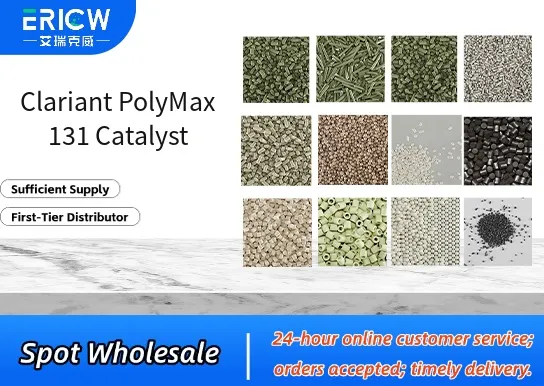
| Chemical Type | Titanium silicalite-1 (TS-1) based heterogeneous catalyst |
| Product Form | Free-flowing granular solid |
| Appearance | Off-white to light gray spherical granules |
| Primary Applications | Hydrogen peroxide-mediated epoxidation of propylene |
| Key Features | High PO selectivity (>95%), low H₂O₂ decomposition, excellent hydrothermal stability |
| Benefits | Reduced waste water treatment load, extended catalyst cycle life, simplified process integration |
| Storage Conditions | Store in sealed containers at ambient temperature; protect from moisture and direct sunlight |
| Handling Precautions | Use in well-ventilated areas; avoid inhalation of dust; refer to Safety Data Sheet (SDS) for full guidance |
Q1: What is the primary function of PolyMax 131 in polyolefin processing?
A: PolyMax 131 is a highly active metallocene-based catalyst system designed to enable precise control over polymer microstructure—particularly for producing linear low-density polyethylene (LLDPE) and ethylene copolymers with narrow molecular weight distribution and uniform comonomer incorporation.
Q2: How does PolyMax 131 differ from conventional Ziegler–Natta catalysts?
A: Unlike traditional Ziegler–Natta systems, PolyMax 131 offers single-site activity, resulting in polymers with superior homogeneity, enhanced mechanical properties, and improved clarity—especially beneficial for high-performance film and packaging applications.
Q3: Is PolyMax 131 compatible with standard slurry or gas-phase polyolefin reactors?
A: Yes, PolyMax 131 is engineered for robust performance in both slurry and gas-phase processes, including common industrial configurations such as loop reactors and fluidized-bed reactors, and demonstrates good stability under typical operating conditions.
Q4: What handling precautions should be observed when using PolyMax 131?
A: As with most organometallic catalysts, PolyMax 131 requires handling under inert atmosphere (e.g., nitrogen or argon), away from moisture, oxygen, and incompatible materials. Storage should be at controlled ambient temperatures in sealed containers to maintain catalytic integrity.
Q5: How is dosage typically determined for PolyMax 131 in commercial formulations?
A: Dosage is formulation- and process-dependent, but PolyMax 131 is generally used at low concentrations relative to traditional catalysts—typically ranging from 0.1% to 2% by weight of total catalyst system—allowing for fine-tuned polymerization kinetics and product property optimization.
Contact With Us:
E-mail: wangxingqiang@ericwchem.com
Have a Questions? Call Us:
Add:
Building A1, Jiete Industrial Park, Huangpu District, Guangzhou City, Guangdong Province, China