English
 Español
 tiếng việt
 русский
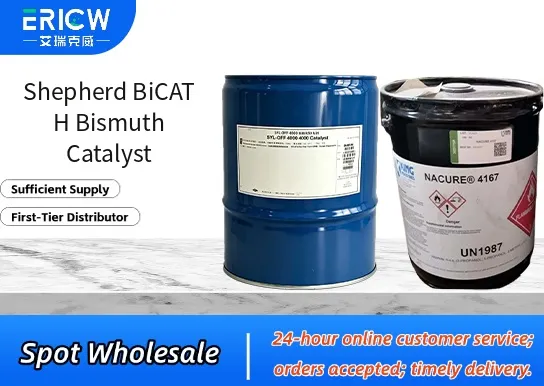
Highly selective bismuth-based catalyst enabling precise control in polycondensation reactions.
Low toxicity profile compared to traditional heavy-metal catalysts such as lead or tin compounds.
Thermally stable up to 220°C, supporting high-temperature polymerization processes without premature decomposition.
Water-tolerant formulation, allowing consistent performance in moisture-sensitive synthesis environments.
Compatible with standard industrial processing equipment and scalable from lab to production batch sizes.
Polyester synthesis, including PET and PBT precursors.
Polyurethane elastomer production requiring low-color, low-odor catalysts.
Bio-based polyesters derived from renewable feedstocks (e.g., PLA copolymerization).
Coating resins where metal residue limits must comply with FDA or EU food-contact regulations.
Adhesive formulations demanding minimal catalytic residue and enhanced shelf-life stability.
| Chemical Type | Bismuth carboxylate complex |
| Product Form | Liquid solution in aromatic hydrocarbon carrier |
| Appearance | Clear, amber-colored liquid |
| Bismuth Content (wt%) | 8.0–9.5% |
| Viscosity (25°C, mPa·s) | 45–75 |
| Density (20°C, g/cm³) | 1.12–1.18 |
| pH (1% aqueous dispersion) | 5.0–6.5 |
| Storage Stability | ≥24 months under sealed, dry, room-temperature conditions |
Q1: What is the primary function of Shepherd BiCAT H in polyurethane systems?
A: Shepherd BiCAT H is a bismuth-based catalyst designed to promote urethane formation (reaction between isocyanates and polyols) with high selectivity and reduced side reactions, such as trimerization or hydrolysis—making it especially suitable for moisture-sensitive or heat-sensitive formulations.
Q2: How does BiCAT H compare to traditional tin catalysts like dibutyltin dilaurate (DBTDL)?
A: BiCAT H offers comparable catalytic activity for urethane bond formation while providing improved hydrolytic stability and lower toxicity profile. Unlike organotin compounds, it is not classified as a reproductive toxin and aligns with evolving regulatory expectations for safer alternatives in industrial coatings and elastomers.
Q3: Is BiCAT H compatible with common polyurethane raw materials, including aromatic and aliphatic isocyanates?
A: Yes—BiCAT H demonstrates broad compatibility with both aromatic (e.g., MDI, TDI) and aliphatic (e.g., HDI, IPDI) isocyanates, as well as polyester and polyether polyols. It remains stable in typical solvent- and water-based systems used in coatings, adhesives, and sealants.
Q4: What is the typical dosage range for BiCAT H in PU formulations?
A: Dosage depends on formulation requirements and desired cure profile, but BiCAT H is typically used at low concentrations—generally ranging from 0.1% to 2% by weight relative to total resin solids—to achieve effective catalysis without compromising pot life or film properties.
Contact With Us:
E-mail: wangxingqiang@ericwchem.com
Have a Questions? Call Us:
Add:
Building A1, Jiete Industrial Park, Huangpu District, Guangzhou City, Guangdong Province, China