English
 Español
 tiếng việt
 русский
AEROSIL® 200 is one of the most widely specified hydrophilic fumed silica grades in the coatings, inks and adhesives industries. Buyers researching it usually need three things answered: what it actually does inside a formulation, how much to use and how to disperse it, and where to source genuine material with complete documentation. This guide covers typical datasheet values, application logic, dispersion practice and a document checklist for procurement teams sourcing from overseas suppliers.
AEROSIL® is a registered trademark of Evonik. Product parameters below are indicative only and must be confirmed against the current official technical data sheet for the exact grade, batch and region.
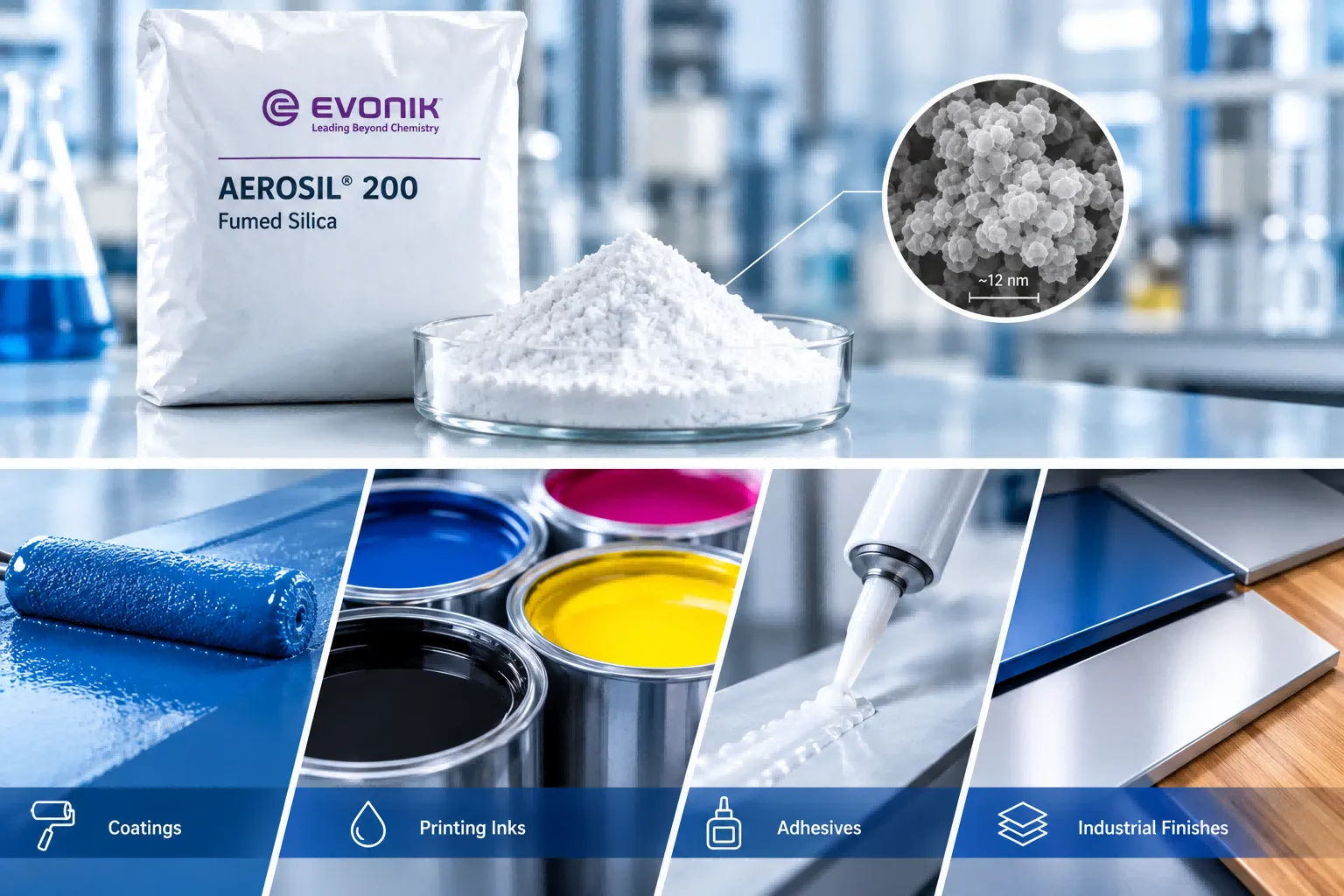
AEROSIL 200 is a synthetic amorphous silica produced by flame hydrolysis of silicon tetrachloride — the process behind the term "fumed silica". Primary particles of roughly 12 nm fuse into aggregates, which agglomerate further into the fluffy white powder supplied to industry.
Its surface carries a high density of silanol (Si–OH) groups, which makes the grade hydrophilic and capable of forming a hydrogen-bonded three-dimensional network in liquid systems. That network is the source of the rheology behaviour formulators rely on: viscosity builds at rest and breaks down under shear.
Reference identifiers often used in purchasing documents:
Chemical description: synthetic amorphous silica, fumed
CAS number: 112945-52-5
EC number: 231-545-4
Supplied form: white, low-density powder
| Property | Typical value | Note |
|---|---|---|
| BET surface area | 200 ± 25 m²/g | Defines the grade family |
| SiO₂ content | ≥ 99.8 wt% | Based on ignited material |
| pH | approx. 3.7–4.5 | In aqueous dispersion per TDS |
| Loss on drying | ≤ 1.5 wt% | 2 h at 105 °C |
| Tamped density | approx. 50 g/l | Compacted bulk density |
| Surface character | Hydrophilic | High silanol density |
Values vary by production site and batch. Always reconcile the quotation, COA and TDS before approving a purchase order.
Thickening and thixotropy. The silica network raises low-shear viscosity without pushing high-shear viscosity up to the same degree. That balance is what allows a coating or adhesive to resist sag at rest while still flowing under application shear.
Anti-settling. In pigmented systems, the network supports pigment and filler particles and slows hard-settling during storage, which reduces redispersion time in the drum or tank.
Sag and edge coverage control. Vertical and complex geometry parts benefit from improved resistance to running, with more uniform film thickness at edges.
Reinforcement. In silicone rubber, sealants and elastomeric systems, the same surface chemistry contributes mechanical reinforcement and tear resistance.
Free flow and anti-caking. Outside liquid systems, AEROSIL 200 is used as a flow aid and anti-caking agent for powders.
Processing behaviour. Because the effect depends on an intact network, shear history, addition order and letdown stage all influence the final result. Two plants using the same grade at the same percentage can obtain different viscosities.
Grade selection is usually the first technical decision, not the dosage. Hydrophilic grades perform best in polar or aqueous media and in systems where hydrogen bonding is welcome. In strongly non-polar systems they are harder to disperse, and a hydrophobically treated grade is normally the practical choice.
| Grade | Surface | BET (approx.) | Systems it fits |
|---|---|---|---|
| AEROSIL 200 | Hydrophilic | 200 m²/g | Polar solvent-borne and water-borne systems, elastomers, general rheology control |
| AEROSIL 380 | Hydrophilic | 380 m²/g | Same families where higher thickening efficiency is required; more demanding to disperse |
| AEROSIL R972 | Hydrophobic (treated) | 110 m²/g | Non-polar solvents, anti-settling and anti-corrosion performance |
| AEROSIL R974 | Hydrophobic (treated) | 170 m²/g | Non-polar systems needing higher thickening than R972 |
A200 is therefore not interchangeable with hydrophobic grades. Substituting a treated grade into an aqueous system, or a hydrophilic grade into a strongly non-polar solvent, tends to produce dispersion defects rather than a simple viscosity shift.
Industrial and protective coatings — anti-settling, sag control, thixotropic adjustment in solvent-borne and water-borne systems
Automotive refinish and OEM primers — pigment suspension and spray behaviour
Printing inks — rheology control, reduced misting and improved transfer behaviour
Adhesives and sealants — non-sag behaviour and viscosity stability during storage
Silicone and rubber compounds — reinforcement and processing consistency
Unsaturated polyester and composites — anti-sag and anti-settling in gel coats and laminating resins
Powder handling — free flow and anti-caking
Specialty systems — including gel-type battery electrolytes, polishing slurries and thermal insulation concepts
Indicative loading levels commonly appear in the range of roughly 0.5–3 wt% for coatings and inks, with higher loadings used in sealants, adhesives and elastomers. The correct level depends on the target viscosity, the target sag resistance, the resin system and the available dispersion energy — so treat every figure as a starting point for laboratory trials rather than a specification.
Practical dispersion notes:
Incorporate under shear. Adding powder to a still batch produces lumps that are difficult to recover later.
Dosing into the mill base or under a high-speed dissolver is the usual route; some systems need bead milling.
Add slowly enough to wet the powder, and control dust generation at the addition point.
Check dispersion quality with a grind gauge or fineness-of-grind reading rather than by eye.
In water-borne systems, pH, ionic content and surfactant package influence the network; confirm stability over the intended shelf life.
In non-polar systems, consider a hydrophobic grade or a pre-dispersion route.
Confirm which stage the silica is added — changes at letdown affect final viscosity and levelling.
AEROSIL 200 is a low-density powder and generates dust. Standard industrial practice applies: local exhaust ventilation at the addition point, appropriate respiratory protection, eye protection and anti-static precautions as described in the current safety data sheet. Spilled material is slippery on hard floors and should be cleaned promptly using dry methods.
Store sealed, dry and away from moisture, and follow first-in-first-out rotation. Moisture uptake degrades dispersion performance before it visibly changes the bag. Shelf-life and storage conditions should be taken from the current TDS or SDS.
Regulatory status varies by grade and market. REACH registration and CLP classification, RoHS statements, and any food-contact or indirect food-contact listing should be confirmed for the specific grade through the supplier's regulatory documents. Do not assume that listing for one grade extends to another.
For overseas buyers, the main procurement risk is not price — it is receiving repackaged, blended or downgraded material without traceable documents. Before placing a first order, request and verify:
Exact grade designation, including any suffix or regional variant
Original manufacturer packaging with intact printing and closure
Batch number on the bag matched to the COA
Current technical data sheet, with its revision date
Current safety data sheet for the destination country
Certificate of analysis for the actual shipped batch
Storage and shelf-life instructions
Distribution or authorization route documentation
Sample availability and sample-to-bulk consistency
Minimum order quantity, lead time and packing configuration
Total landed cost, including freight and documentation fees
For a second and third shipment, compare the COA data against the first batch. A supplier who cannot produce batch-level documents consistently is a supply risk regardless of the unit price.
What is AEROSIL 200 used for? Rheology control, anti-settling and sag resistance in coatings, inks and adhesives, plus reinforcement in elastomers and free-flow behaviour in powders.
What is the difference between AEROSIL 200 and AEROSIL R972? A200 is hydrophilic with a nominal 200 m²/g surface area and is normally used in polar or aqueous systems. R972 is surface-treated and hydrophobic, with a lower nominal surface area, and is aimed at non-polar systems.
What is a typical dosage? Commonly quoted starting points are around 0.5–3 wt% in coatings and inks, higher in sealants and elastomers. Confirm by trial in your own formulation.
Can AEROSIL 200 be used in water-borne coatings? Yes, and it is one of its frequent applications, provided the dispersion route and pH control suit the system.
Does it affect gloss or transparency? At higher loadings it can influence surface appearance in some systems. Matting effects are normally delivered by dedicated matting agents. Test at application-relevant film thickness.
Is AEROSIL 200 hazardous? Standard grades are not classified as hazardous under CLP, but it is a dust-generating powder. Follow the SDS for ventilation, PPE and housekeeping.
What is the shelf life? Take the figure from the current TDS and storage guidance. Keeping containers sealed and dry matters more than the nominal date in practice.
Where can I buy AEROSIL 200 in small quantities? Speciality distributors that support sampling and small-lot supply are the usual route for trials and mid-scale production.
A200 or A380? A380 has a higher surface area and delivers more thickening and reinforcement per unit weight, but it is harder to disperse and less forgiving in production.
Guangzhou Eric Wei Chemical Co., Ltd. (brand: ERICW) is a speciality chemical supplier and distribution platform based in Huangpu District, Guangzhou, China, reporting a portfolio of more than 50 product series and 30,000-plus SKUs across resins, additives, pigments, fillers and solvents.
Company-stated capabilities relevant to AEROSIL 200 sourcing:
Distribution of Evonik, BASF, Clariant, Croda and Wacker product lines under stated authorizations, supplied with original COA, TDS and MSDS documentation
Small-lot and sample-level supply rather than container-only terms
AI-assisted product selection and digital batch traceability tools
A stated cooperation with the Hebei Waterborne Coatings Industrial Technology Research Institute, with access to analytical instrumentation and patent resources
Business coverage spanning South and East China, Southeast Asia, the Middle East, Africa, North America and Europe
Verified supplier status completed through CTI testing in October 2025, and a vice-chairman position in the ninth council of the Hebei Adhesive and Coatings Association
Website: https://www.ericwchem.com
Business contact: wangxingqiang@ericwchem.com
Disclaimer
This material is for marketing reference only and does not replace professional technical, legal or procurement advice. Product parameters, prices, certifications and supply status vary by batch and market. Customers must check official TDS/SDS/COA and perform self-testing before purchase.
All stated performance data and business information require independent verification. All trademarks are proprietary to their respective holders without implied partnership or endorsement.

Vice Chairman of the Coatings and Adhesives Association
Senior New Materials R&D Engineer
Bachelor of Engineering
General Manager
Professional Experience: With 10 years of experience in the fine chemical industry, the team has served over 10,000 clients. Committed to providing one-stop fine chemical services for global clients and helping them optimize the selection of chemical materials.
This is the last one.