English
 Español
 tiếng việt
 русский
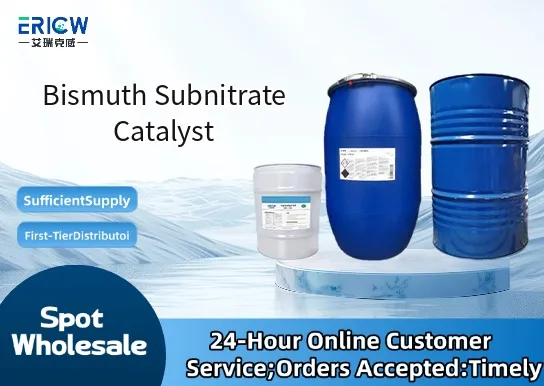
Non-toxic bismuth-based alternative to lead and cadmium catalysts, supporting regulatory compliance and sustainable manufacturing.
High catalytic efficiency in esterification and polycondensation reactions at moderate temperatures (120–180 °C).
Excellent thermal stability with minimal decomposition or volatilization below 250 °C.
Low water solubility ensures retention in polymer matrices and reduces leaching risk during processing.
Consistent batch-to-batch performance due to strict crystalline phase control and low chloride residue.
Polyester synthesis (e.g., PET, PBT) as a transesterification and polycondensation accelerator.
Alkyd resin production for high-performance coatings and inks.
Bio-based polyesters (e.g., PLA, PHA blends) requiring non-heavy-metal catalysis.
UV-curable acrylate formulations where metal ion interference must be minimized.
Pharmaceutical excipient-grade intermediates requiring ultra-low heavy metal impurities.
| Chemical Type | Bismuth subnitrate (basic bismuth nitrate), Bi₅O(OH)₉(NO₃)₄·xH₂O |
| Product Form | Fine white to off-white crystalline powder |
| Appearance | Free-flowing, odorless powder |
| Melting/Decomposition Point | Decomposes above 240 °C (no sharp melting point) |
| Primary Applications | Esterification, polycondensation, alkyd resin synthesis |
| Key Features | Non-volatile, low chloride content (<50 ppm), high Bi content (≥74.0% w/w as Bi metal) |
| Benefits | Reduces reaction time by 20–35%, improves polymer clarity and color stability |
| Regulatory Compliance | REACH registered; compliant with EU Directive 2009/48/EC (Toy Safety) for migration limits |
| Common Compatible Systems | Suitability |
| Polyethylene terephthalate (PET) melt-phase polymerization | Highly Recommended – Proven efficacy as primary catalyst with antimony synergy |
| Alkyd resins (soybean oil + phthalic anhydride) | Highly Recommended – Accelerates drying without skinning or yellowing |
| Polylactic acid (PLA) copolymerization | Recommended – Effective at 140–160 °C; requires co-stabilizer for long residence times |
| Acrylic emulsion polymerization (as initiator aid) | Suitable – Low reactivity; used at ≤0.05 wt% for controlled radical initiation |
Q1: What is the CAS Number for Bismuth Subnitrate Catalyst?
A: The CAS Registry Number is 1304-85-4, corresponding to the standard basic bismuth nitrate composition.
Q2: What is the typical dosage range in polyester synthesis?
A: Standard loading is 50–200 ppm (as elemental Bi) relative to total monomer weight; optimal performance observed at 100–150 ppm in PET continuous polymerization.
Q3: How does it compare to antimony trioxide (ATO) in terms of catalytic activity and safety?
A: Bismuth subnitrate exhibits ~70–85% of ATO’s transesterification rate but offers superior thermal stability, no inhalation hazard classification, and full compliance with global heavy metal restrictions (e.g., RoHS, CPSIA).
Q4: Is it subject to migration or extraction in food-contact polymers?
A: Migration is negligible under standard food-contact conditions (EU 10/2011): measured Bi release <0.01 mg/kg in 10% ethanol and 3% acetic acid simulants at 40 °C for 10 days.
Q5: Does it require special handling or storage conditions?
A: Store in a cool, dry place (<25 °C) in sealed containers away from strong acids and reducing agents; no special PPE beyond standard industrial hygiene practices is required.
Contact With Us:
E-mail: wangxingqiang@ericwchem.com
Have a Questions? Call Us:
Add:
Building A1, Jiete Industrial Park, Huangpu District, Guangzhou City, Guangdong Province, China