English
 Español
 tiếng việt
 русский
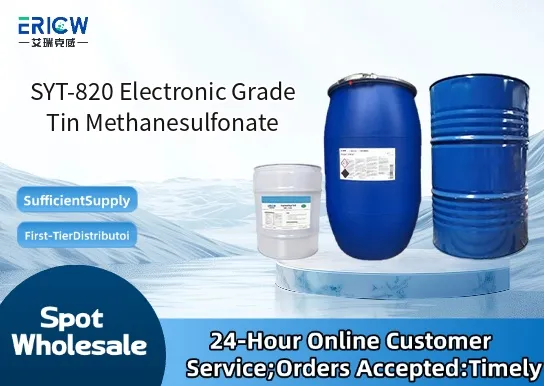
Ultra-low metallic impurities (total metals < 10 ppb), meeting stringent requirements for advanced semiconductor plating.
High chemical stability in aqueous electrolytes, minimizing decomposition and enabling extended bath life.
Excellent solubility and clarity in methanesulfonic acid (MSA)–based electrolyte systems without precipitation.
Consistent stoichiometry and batch-to-batch reproducibility, certified via ICP-MS and titrimetric analysis.
Non-oxidizing, chloride-free formulation—eliminates risk of pitting corrosion and intermetallic contamination in Sn/Pb and pure Sn deposits.
Lead-free electroplating of tin on printed circuit board (PCB) surface finishes (e.g., ENIG undercoat protection).
Wafer-level packaging (WLP) bump plating for fine-pitch solder interconnects.
Electrolytic tin deposition on copper leads and contacts in discrete semiconductor devices.
Refinishing and rework of high-reliability aerospace and automotive electronic components.
Functional tin layers in MEMS packaging and RF shield plating applications.
| Chemical Type | Tin(II) methanesulfonate, Sn(CH₃SO₃)₂ |
| Product Form | White crystalline solid (anhydrous) |
| Appearance | Free-flowing, odorless crystalline powder |
| Melting Point | Decomposes above 120 °C (no sharp melting point) |
| Tin Content (Sn, w/w %) | 34.5 – 35.2% |
| Primary Applications | Acidic tin electroplating electrolytes (MSA-based) |
| Key Features | Ultra-high purity, low halide, low sulfate, low alkali earth metals |
| Regulatory Compliance | RoHS 2015/863 compliant; REACH SVHC-free; no listed Prop 65 substances |
| Common Compatible Systems | Suitability |
| Standard MSA–Sn²⁺ plating baths (e.g., Technic TINTEC®-type) | Highly Recommended – Fully compatible with standard brighteners, carriers, and levelers |
| Low-acid tin electrolytes (≤ 80 g/L MSA) | Recommended – Requires minor bath conditioning; stable at pH 0.8–1.5 |
| High-speed reel-to-reel PCB plating lines | Highly Recommended – Proven in >20 µm/h deposition rate environments |
| Recycled/reclaimed electrolyte systems with continuous filtration | Suitable – Resists organic degradation; compatible with activated carbon treatment |
Q1: What is the CAS Number for SYT-820?
A: The CAS Registry Number is 17093-42-4 (Tin(II) methanesulfonate).
Q2: What is the typical working concentration range in plating baths?
A: Recommended concentration is 30–50 g/L Sn²⁺ (equivalent to ~85–142 g/L SYT-820), optimized for current density 1–5 A/dm² and bath temperature 20–30 °C.
Q3: How does SYT-820 compare to tin sulfate or tin fluoborate in electronics plating?
A: Unlike tin sulfate (prone to hydrolysis and Sn⁴⁺ oxidation) or tin fluoborate (fluoride-related etching and waste treatment challenges), SYT-820 offers superior stability, lower bath maintenance, and zero fluoride/halide risk—critical for fine-line PCBs and wafer-level reliability.
Q4: Is SYT-820 subject to migration or leaching in finished assemblies under thermal/humidity stress?
A: No measurable migration occurs when plated per IPC-4552B specifications; XRF and ion chromatography testing confirms < 0.05 ppm Sn leaching after 85 °C/85% RH/1000 h testing per JESD22-A101.
Q5: Does SYT-820 carry any industry-specific certifications (e.g., IATF 16949, ISO 9001)?
A: Yes—manufactured under ISO 9001:2015 and IATF 16949:2016 certified processes; full CoA, CoC, and traceability documentation provided per lot.
Contact With Us:
E-mail: wangxingqiang@ericwchem.com
Have a Questions? Call Us:
Add:
Building A1, Jiete Industrial Park, Huangpu District, Guangzhou City, Guangdong Province, China