English
 Español
 tiếng việt
 русский
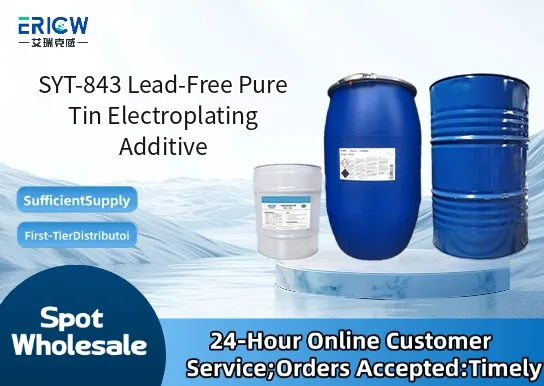
Enables bright, uniform, and solderable pure tin deposits without lead or other restricted heavy metals.
Delivers excellent throwing power and micro-throwing power for consistent coverage on complex geometries and high-aspect-ratio features.
Stabilizes acidic methanesulfonic acid (MSA)-based tin plating baths with low additive consumption and extended bath life.
Provides outstanding deposit ductility and thermal cycling resistance—critical for automotive and power electronics interconnects.
Compatible with automated dosing systems and supports robust process control under varying current densities (1–5 A/dm²).
Electroplated terminations and leads for passive components (resistors, capacitors, inductors).
Connector contacts and shielding cans in automotive ECUs and ADAS modules.
Solderable finishes on PCB edge connectors, gold-finger undercoats, and flex circuit tabs.
Leadframes for discrete semiconductors and power modules requiring RoHS-compliant, whisker-resistant tin.
High-reliability aerospace and medical device interconnects where pure tin integrity is mandated.
| Chemical Type | Organic sulfonamide-based complexing and brightening agent blend |
| Product Form | Aqueous liquid concentrate |
| Appearance | Clear to slightly hazy, light amber liquid |
| pH (as supplied) | 5.0 – 6.5 (25 °C) |
| Density (25 °C) | 1.08 – 1.12 g/cm³ |
| Primary Applications | Bright, low-stress pure tin electroplating in MSA-based electrolytes |
| Key Features | Whisker-suppressing formulation; non-cyanide; halogen-free |
| Regulatory Compliance | RoHS 2015/863 compliant; REACH SVHC-free; no PFAS, no nitrosamines |
| Common Compatible Systems | Suitability |
| Methanesulfonic Acid (MSA) Tin Baths (e.g., SYT-TinBase series) | Highly Recommended – Optimized performance with SYT-843; standard operating range: 10–15 g/L Sn²⁺, 120–160 g/L MSA |
| Ethanesulfonic Acid (ESA) Tin Electrolytes | Recommended – Requires minor bath adjustment; stable deposition at 25–40 °C |
| Low-acid organic tin formulations (non-MSA) | Suitable – Functional with validation; may require increased agitation and controlled current density |
| Alkaline stannate baths | Not Compatible – SYT-843 is formulated exclusively for acidic tin systems |
Q1: What is the CAS Registry Number for SYT-843?
A: SYT-843 is a proprietary multi-component formulation and does not have a single CAS number; individual major constituents are documented in the full Safety Data Sheet (SDS) upon request.
Q2: What is the recommended working concentration and replenishment rate?
A: Initial dosage: 8–12 mL/L; maintain via coulometric monitoring at 0.8–1.2 mL per 100 Ah of plated tin. Replenish daily based on ampere-hour throughput and Hull cell verification.
Q3: How does SYT-843 compare to conventional bright tin additives containing benzene sulfonates or formaldehyde derivatives?
A: SYT-843 replaces hazardous formaldehyde donors and aromatic sulfonates with hydrolytically stable, biodegradable sulfonamide derivatives—reducing bath decomposition, improving wastewater treatability, and eliminating carcinogenic byproduct formation during operation.
Q4: Does SYT-843 meet JEDEC JESD22-A121B (tin whisker acceleration) requirements?
A: Yes—deposits from SYT-843-enabled baths consistently pass 1000-hour 150 °C bake + 85% RH storage per JESD22-A121B when applied over copper or nickel underlayers with proper thickness control (≥ 8 µm).
Q5: Is there any risk of tin ion migration or extractable organics into adjacent dielectrics in high-density packaging?
A: No measurable migration occurs under IPC-TM-650 2.6.25 testing conditions (85 °C / 85% RH, 1000 V bias); SYT-843’s non-ionic, high-molecular-weight additives remain fully bound in the deposit matrix and show < 0.5 ppm organic leachate in IEC 62321-8 extraction assays.
Contact With Us:
E-mail: wangxingqiang@ericwchem.com
Have a Questions? Call Us:
Add:
Building A1, Jiete Industrial Park, Huangpu District, Guangzhou City, Guangdong Province, China