English
 Español
 tiếng việt
 русский
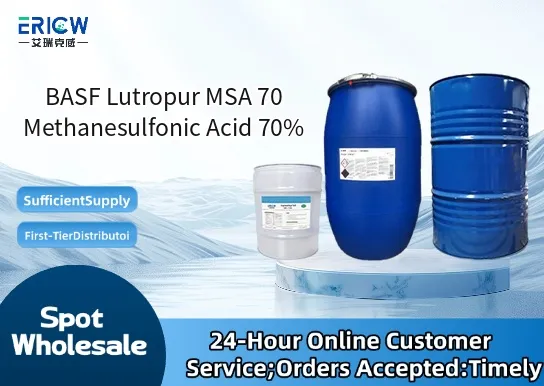
High-purity, low-metal-content formulation optimized for electroplating and electronics-grade applications.
Non-oxidizing, non-volatile strong organic acid with excellent thermal and hydrolytic stability.
Biodegradable and inherently low-toxicity compared to traditional mineral acids (e.g., sulfuric or hydrochloric acid).
Low vapor pressure and minimal fuming—enhances workplace safety and reduces ventilation requirements.
Consistent batch-to-batch quality supported by BASF’s stringent GMP-aligned manufacturing controls.
Copper, tin, and lead-tin electroplating electrolytes—especially in high-precision PCB and semiconductor packaging.
Catalyst for esterification, alkylation, and condensation reactions in fine chemical synthesis.
Acid catalyst and pH adjuster in pharmaceutical active ingredient (API) manufacturing processes.
Electrolyte component in redox flow batteries and metal recovery systems.
Stripping and cleaning agent for precision metal surfaces prior to coating or bonding.
| Chemical Type | Methanesulfonic acid (MSA), organic sulfonic acid |
| Product Form | Liquid solution (aqueous) |
| Appearance | Clear, colorless to pale yellow liquid |
| Concentration | 70.0 ± 1.0 wt.% methanesulfonic acid |
| Specific Gravity (20 °C) | 1.38–1.40 g/cm³ |
| pH (1% aqueous solution) | ~0.9–1.2 |
| Key Features | Low chloride & sulfate content; trace metals (Fe, Cu, Ni, Pb) < 1 ppm each |
| Regulatory Compliance | REACH registered; compliant with USP/EP excipient guidelines for select grades; SDS available per OSHA/GHS |
| Common Compatible Systems | Suitability |
| Copper pyrophosphate plating baths | Highly Recommended – Enhances bath stability and deposit uniformity without complexing interference |
| Tin-lead methanesulfonate electrolytes | Highly Recommended – Enables bright, low-porosity deposits with minimal dendrite formation |
| Polypropylene (PP), polyethylene (PE), and PVDF piping/tanks | Recommended – Excellent chemical resistance at ambient to 50 °C; avoid prolonged contact with carbon steel or aluminum |
| Ion-exchange resins (strong acid cation types) | Suitable – Effective regeneration agent; compatible with standard gel-type and macroporous resins |
Q1: What is the CAS Number for BASF Lutropur MSA 70?
A: The CAS Number for methanesulfonic acid is 75-75-2. BASF Lutropur MSA 70 is a 70% aqueous solution of this compound, conforming to the same CAS designation.
Q2: How does the recommended dosage compare to sulfuric acid in copper electroplating baths?
A: Typically, 1.2–1.5× the molar equivalent of sulfuric acid is used due to MSA’s monoprotic nature and lower conductivity; however, total acid concentration is optimized empirically per bath formulation to maintain conductivity >25 mS/cm and minimize anode passivation.
Q3: Is BASF Lutropur MSA 70 suitable for use in food-contact or pharmaceutical processing equipment cleaning?
A: Yes—when used as directed and thoroughly rinsed, it meets criteria for indirect food-contact applications under FDA 21 CFR §173.350 and is referenced in EMA/CHMP guidelines for cleaning validation in API manufacturing, provided final rinse water testing confirms residual limits (≤10 ppm MSA).
Q4: Does Lutropur MSA 70 exhibit migration or leaching risks when used in polymer-based electrolyte systems?
A: No significant migration occurs in cross-linked polymer matrices (e.g., Nafion®, sulfonated polyetheretherketone); MSA remains ionically bound or volatilizes fully during curing. Leaching is negligible (<0.05 ppm) after post-treatment washing per ASTM D1388.
Contact With Us:
E-mail: wangxingqiang@ericwchem.com
Have a Questions? Call Us:
Add:
Building A1, Jiete Industrial Park, Huangpu District, Guangzhou City, Guangdong Province, China