English
 Español
 tiếng việt
 русский
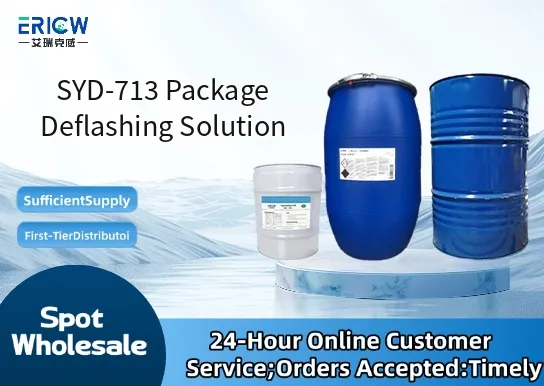
Non-corrosive formulation designed specifically for precision deflashing of molded plastic and elastomeric electronic packages without damaging sensitive substrates or metallization.
Low-volatility, non-halogenated chemistry enabling safe operation in standard industrial degreasing and batch immersion systems.
Excellent flash removal efficiency on thermoset epoxies, silicone encapsulants, and polyamide-based molding compounds.
pH-neutral (6.8–7.2) aqueous concentrate — ready-to-use after dilution with deionized water; no acid/base handling hazards.
Compatible with automated spray, ultrasonic, and immersion cleaning equipment; supports multi-cycle bath life with minimal additive replenishment.
Post-molding deflashing of IC leadframes, QFN, SOIC, and BGA semiconductor packages.
Cleaning flash residues from automotive sensor housings and connector modules made of PBT, LCP, or epoxy-molded compounds.
Deflashing medical device components such as implantable housing assemblies and diagnostic cartridge carriers.
Surface preparation prior to conformal coating, wire bonding, or plasma activation in high-reliability electronics manufacturing.
Removal of gate vestiges and parting line flash from precision injection-molded microfluidic and optical polymer parts.
| Chemical Type | Aqueous-based, non-ionic surfactant system with selective organic solubilizers |
| Product Form | Concentrated liquid (ready-to-dilute) |
| Appearance | Clear, pale amber liquid, free of sediment or phase separation |
| pH (1% w/w in DI water, 25°C) | 6.9–7.1 |
| Density (25°C) | 1.04–1.06 g/cm³ |
| Primary Applications | Deflashing, post-mold cleaning, flash residue dissolution |
| Key Features | Non-foaming, low odor, non-oxidizing, compatible with aluminum, copper, and silver metallizations |
| Regulatory Compliance | REACH SVHC-free; RoHS 2015/863 compliant; no listed Prop 65 chemicals |
| Common Compatible Systems | Suitability |
| Ultrasonic Cleaning Baths (40–60 kHz) | Highly Recommended – Optimal flash removal at 50–60°C with 3–10 min dwell time |
| Batch Immersion Tanks with Temperature Control | Highly Recommended – Stable performance up to 70°C; bath life ≥ 72 hours under typical load |
| Inline Spray Washers (Stainless Steel Construction) | Recommended – Requires filtration ≤ 25 µm; compatible with stainless steel and EPDM seals |
| Recirculating Hot-Dip Deflashing Units | Suitable – Effective with mild agitation; avoid prolonged exposure above 75°C |
Q1: What is the CAS Registry Number for SYD-713?
A: SYD-713 is a proprietary multi-component formulation; individual ingredients are disclosed under confidentiality and do not carry a single CAS number. Full compositional disclosure is available under NDA for qualified customers.
Q2: What is the recommended working concentration and temperature range?
A: Dilute SYD-713 at 5–15% v/v in deionized water. Optimal performance occurs between 50°C and 65°C; maximum recommended continuous operating temperature is 70°C.
Q3: How does SYD-713 compare to solvent-based deflashers like toluene or DCM?
A: Unlike halogenated or aromatic solvents, SYD-713 eliminates VOC emissions, workplace exposure risks, and hazardous waste disposal requirements while delivering comparable flash lift performance on epoxy and silicone mold compounds.
Q4: Is SYD-713 validated for use in medical device manufacturing per ISO 10993 or USP <87>/<88>?
A: SYD-713 has undergone extractables profiling per USP <87> (in vitro cytotoxicity) and shows no adverse response. Full ISO 10993 biocompatibility testing is customer-specific and performed on final cleaned parts—not the solution alone.
Q5: Does SYD-713 cause leaching or migration of additives from engineered plastics during deflashing?
A: No significant additive migration has been observed in validation studies with common molding compounds (e.g., EMC-7000, Sumitomo EME-G700), provided process parameters (concentration, time, temperature) remain within specified limits.
Contact With Us:
E-mail: wangxingqiang@ericwchem.com
Have a Questions? Call Us:
Add:
Building A1, Jiete Industrial Park, Huangpu District, Guangzhou City, Guangdong Province, China