English
 Español
 tiếng việt
 русский
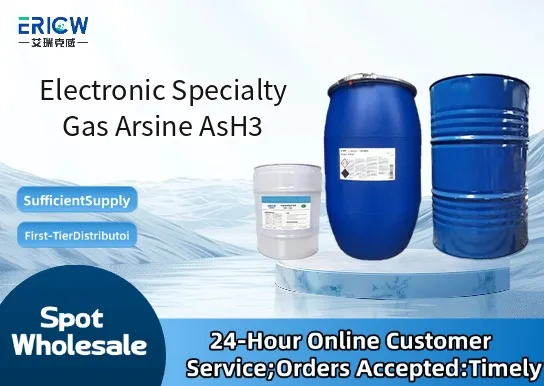
Ultra-high purity (99.999% / 5.0 grade) with stringent particulate and moisture control for semiconductor-grade deposition processes.
Consistent cylinder-to-cylinder reproducibility, certified via GC-MS and FTIR trace impurity analysis per SEMI F57 standards.
Stabilized packaging in electropolished stainless-steel cylinders with VCR® metal gasket seals to prevent adsorption and degradation.
Comprehensive lot-specific Certificates of Analysis (CoA) including ppb-level detection of H₂O, O₂, CO, CO₂, and hydrocarbons.
Integrated leak-tight delivery systems with ASME B31.3-compliant gas panels and dedicated arsine-compatible regulators.
Metalorganic chemical vapor deposition (MOCVD) of gallium arsenide (GaAs) layers for high-frequency RF devices and optoelectronic lasers.
Molecular beam epitaxy (MBE) of III–V compound semiconductors in advanced power electronics and photovoltaic cell fabrication.
Doping of silicon wafers during ion implantation and in-situ doping in epitaxial silicon-germanium (SiGe) growth.
Atomic layer deposition (ALD) precursors for arsenide-based barrier and interface engineering in advanced logic nodes.
Research-scale synthesis of low-dimensional arsenide nanomaterials (e.g., InAs quantum dots, GaAs nanowires) under controlled UHV environments.
| Chemical Type | Inorganic hydride, Group V precursor |
| Product Form | Compressed liquefied gas in high-pressure cylinder |
| Appearance | Colorless gas with garlic-like odor (detectable at ~0.5 ppm) |
| Melting Point | −62.5 °C |
| Boiling Point | −62.4 °C (sublimes at ambient pressure) |
| Primary Applications | GaAs, InAs, AlAs epitaxy; n-type doping; compound semiconductor manufacturing |
| Key Features | High reactivity, low decomposition temperature (~300 °C), excellent As incorporation efficiency |
| Regulatory Compliance | OSHA PEL: 0.005 ppm (TWA); ACGIH TLV: 0.005 ppm; GHS Hazard Class: Acute Toxicity (Category 2), Pyrophoric Gas |
| Common Compatible Systems | Suitability |
| Veeco GEN10 MOCVD Reactor | Highly Recommended – Factory-integrated arsine manifold with dual-stage purging and real-time H₂S scrubber monitoring |
| Riber Compact 21 MBE System | Highly Recommended – UHV-compatible effusion cells with calibrated As effusion source and residual gas analyzer (RGA) integration |
| Applied Materials Centura® Epitaxy Platform | Recommended – Requires retrofit with arsine-specific gas delivery module (GDM) and enhanced exhaust abatement |
| ASM Epsilon® 200 ALD System | Suitable – Compatible with optional high-reactivity precursor kit; requires purge optimization and extended N₂ flush cycles |
Q1: What is the CAS Registry Number for Arsine (AsH₃)?
A: The CAS Registry Number for arsine is 7784-42-1.
Q2: How is arsine typically handled to minimize exposure risk during transfer and use?
A: Arsine must be used only in certified ventilated gas cabinets with continuous H₂S/AsH₃ monitoring, double-contained tubing, and automatic emergency shutoff valves; all personnel require HAZMAT training and real-time personal air sampling.
Q3: How does electronic-grade AsH₃ differ from technical-grade arsine in terms of impurity profile?
A: Electronic-grade AsH₃ limits total metallic impurities to <1 ppt (by ICP-MS), non-volatile residues to <1 ng/cylinder, and excludes phosphine (PH₃) and silane (SiH₄) contaminants that cause defect nucleation in epitaxial layers.
Q4: Is arsine compatible with standard stainless-steel gas lines, or does it require specialized materials?
A: Standard 316L SS is acceptable *only* when electropolished (Ra < 0.4 µm), passivated, and dedicated exclusively to arsine; copper, brass, or aluminum components must be avoided due to catalytic decomposition and embrittlement risks.
Contact With Us:
E-mail: wangxingqiang@ericwchem.com
Have a Questions? Call Us:
Add:
Building A1, Jiete Industrial Park, Huangpu District, Guangzhou City, Guangdong Province, China