English
 Español
 tiếng việt
 русский
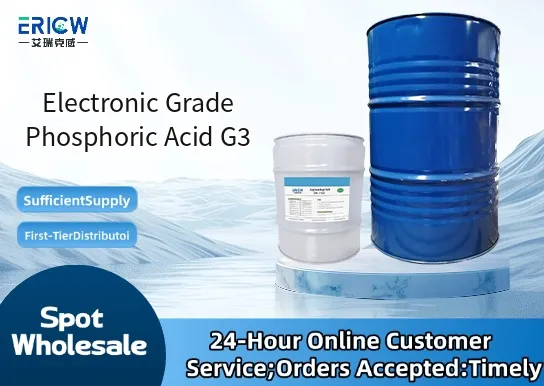
Ultra-low metallic impurities (≤10 ppt for Na, K, Ca, Fe, Cu, Ni, Cr, Zn, Al)
Exceptional particle control (<1 particle/mL @ ≥0.1 μm in 15 μm filtered solution)
Consistent high purity with strict lot-to-lot reproducibility (certified per SEMI C1–C12 standards)
Stabilized formulation minimizing phosphoric acid decomposition and volatile byproduct formation
Manufactured and packaged under ISO Class 4 (Class 10) cleanroom conditions with nitrogen-purged HDPE carboys
Silicon wafer cleaning prior to epitaxial growth or gate oxide deposition
Photoresist stripping in advanced logic and memory device fabrication
Etching of silicon nitride (Si₃N₄) layers in CMOS and DRAM processes
Surface passivation treatment for high-voltage power semiconductor substrates
Pre-diffusion cleaning step in MEMS and RF-SOI manufacturing flows
| Chemical Type | Orthophosphoric acid (H₃PO₄), aqueous solution |
| Product Form | Liquid concentrate (85.0 ± 0.3 wt% H₃PO₄ in deionized water) |
| Appearance | Clear, colorless, odorless liquid; no visible particles or haze |
| Primary Applications | Wafer surface preparation, Si₃N₄ etch, photoresist removal, pre-deposition cleaning |
| Key Features | G3 grade per SEMI C37 standard; meets JIS K 8965:2020 Class A requirements |
| Benefits | Minimizes pattern collapse, reduces defect density (≤0.05 defects/cm² after rinse), enables sub-28 nm node compatibility |
| Regulatory Compliance | REACH compliant; RoHS 2015/863 Annex II compliant; non-REACH SVHC listed |
| Packaging | 20 L and 200 L nitrogen-sealed, fluoropolymer-lined HDPE carboys with double O-ring seals |
| Common Compatible Systems | Suitability |
| SEMI-standard wet bench (e.g., Modutek, Entegris, Tokyo Electron) | Highly Recommended – Fully compatible with quartz, PFA, and PVDF fluidic pathways |
| Single-wafer spin-rinse-dry (SRD) tools (e.g., Lam Research SPIN, SCREEN CleanTrack) | Highly Recommended – Validated for low-metal dispersion and uniform film removal |
| Batch immersion systems with Teflon-coated tanks | Recommended – Requires dedicated filtration (0.1 μm PTFE) and recirculation monitoring |
| Inline dilution systems (e.g., Entegris DSI Series) | Suitable – Compatible with stainless steel 316L and EPDM-free seals when using certified components |
Q1: What is the CAS Number for Electronic Grade Phosphoric Acid G3?
A: The CAS Number is 7664-38-2 — identical to reagent-grade phosphoric acid, as G3 denotes purity grade, not chemical structure.
Q2: What is the recommended process concentration and temperature range for Si₃N₄ etching?
A: Standard process uses 85 wt% concentration at 160–180 °C; for critical dimension control, dilution to 75–80 wt% with UPW and temperature stabilization at ±0.5 °C is advised.
Q3: How does G3 differ from G2 or G4 grades in practical use?
A: G3 offers optimal balance: tighter metallic specs than G2 (10× lower Na/K), but broader thermal stability and lower cost than G4; G4 adds ultra-low anions (Cl⁻, SO₄²⁻ < 5 ppt) and is reserved for EUV mask cleaning.
Q4: Is migration or leaching of extractables observed in contact with fluoropolymer piping?
A: No significant migration is detected under standard operating conditions (≤180 °C, ≤72 h exposure); certified PFA and ETFE tubing show <0.1 ppb metal leachate per ASTM F2129 electrochemical testing.
Contact With Us:
E-mail: wangxingqiang@ericwchem.com
Have a Questions? Call Us:
Add:
Building A1, Jiete Industrial Park, Huangpu District, Guangzhou City, Guangdong Province, China