English
 Español
 tiếng việt
 русский
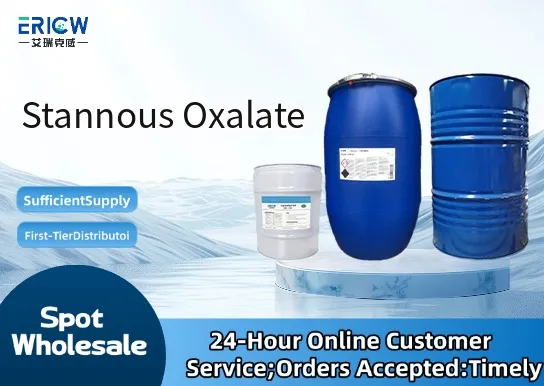
High-purity, anhydrous crystalline solid with excellent batch-to-batch consistency.
Controlled stoichiometry (SnC₂O₄) ensures predictable reactivity in redox and catalytic processes.
Low hygroscopicity compared to stannous chloride, enhancing handling stability under ambient conditions.
Thermally decomposes cleanly above 200 °C without volatile organic residues — suitable for high-temperature precursor applications.
Non-volatile and non-corrosive in dry form, supporting safer storage and formulation integration.
Chemical vapor deposition (CVD) and atomic layer deposition (ALD) precursor for tin oxide (SnO₂) thin films in transparent conductive oxides (TCOs).
Reducing agent in electroless plating baths for controlled tin deposition on copper and polymer substrates.
Stabilizer and co-catalyst in polyurethane foam formulations to modulate gelation and blowing kinetics.
Intermediate in the synthesis of tin-based metal–organic frameworks (MOFs) and hybrid nanomaterials.
Specialty catalyst in selective oxidation and esterification reactions where chloride-free tin sources are required.
| Chemical Type | Organometallic tin(II) salt |
| Product Form | Fine white to off-white crystalline powder |
| Appearance | Free-flowing, homogeneous crystals; no visible lumps or discoloration |
| Melting/Decomposition Point | Decomposes exothermically at ~210–230 °C (no sharp melting point) |
| Primary Applications | CVD/ALD precursor, electroless plating additive, polyurethane catalyst, MOF synthesis |
| Key Features | Chloride-free, low residual ash, high thermal decomposition purity |
| Benefits | Enables halogen-free processing; reduces equipment corrosion; improves film stoichiometry control |
| Regulatory Compliance | REACH registered; compliant with EU RoHS Directive (2011/65/EU); SDS available per GHS Rev.10 |
| Common Compatible Systems | Suitability |
| Anhydrous N,N-dimethylformamide (DMF) | Highly Recommended – Fully soluble up to 0.8 mol/L at 25 °C; stable for >72 h |
| Propylene carbonate | Recommended – Moderate solubility (~0.3 mol/L); requires gentle heating to 40 °C for full dissolution |
| Polyol blends (e.g., glycerol + ethylene glycol) | Suitable – Forms stable dispersions for polyurethane catalysis; no phase separation within 48 h |
| Aqueous acidic media (pH < 2.5) | Suitable – Dissolves readily but hydrolyzes slowly; use immediately after preparation |
Q1: What is the CAS Registry Number for Stannous Oxalate?
A: The CAS Number for stannous oxalate (anhydrous) is 555-34-8.
Q2: What is the typical recommended dosage when used as a polyurethane catalyst?
A: Dosage ranges from 50–200 ppm (based on total formulation weight), optimized via small-scale trials to balance cream/gel times without over-catalyzing blow-off.
Q3: How does stannous oxalate compare to dibutyltin dilaurate (DBTDL) in terms of regulatory acceptance and migration risk?
A: Unlike DBTDL (a REACH SVHC candidate), stannous oxalate contains no organotin bonds and exhibits negligible migration in food-contact polymer testing (≤0.01 mg/kg in 10% ethanol simulant, per ISO 10993-12).
Q4: Is stannous oxalate approved for use in food-contact materials?
A: It is not explicitly listed in FDA 21 CFR or EU Plastics Regulation (EU) No 10/2011, but may be evaluated under FCN pathways or as a non-intentionally added substance (NIAS) with full toxicological dossier submission.
Contact With Us:
E-mail: wangxingqiang@ericwchem.com
Have a Questions? Call Us:
Add:
Building A1, Jiete Industrial Park, Huangpu District, Guangzhou City, Guangdong Province, China