English
 Español
 tiếng việt
 русский
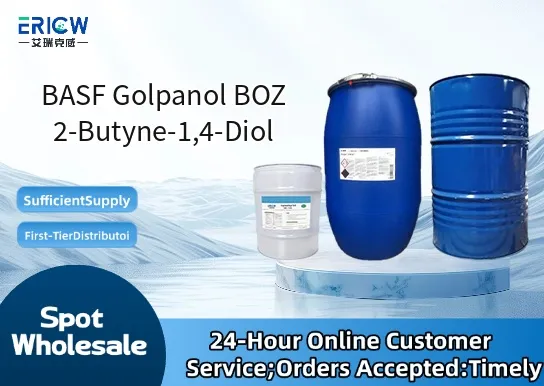
High-purity crystalline diol with exceptional chemical stability under neutral and mildly acidic conditions.
Low volatility and negligible vapor pressure, supporting safe handling and reduced workplace exposure risk.
Excellent reactivity as a building block for heterocycles, surfactants, and corrosion inhibitors via alkyne functionalization.
Controlled synthesis pathway ensures batch-to-batch consistency and low heavy metal impurities (≤5 ppm total metals).
Non-ionic character enables broad compatibility in aqueous and polar organic media without foaming or emulsification issues.
Intermediate in the synthesis of pyrazoles, triazoles, and other nitrogen-containing heterocycles for agrochemical actives.
Co-monomer in high-performance polyurethane dispersions for automotive and industrial coatings.
Key precursor for non-ionic, low-foam surfactants used in metalworking fluid formulations.
Stabilizer and chelating agent in electroplating baths—particularly for nickel and copper deposition processes.
Building block for specialty corrosion inhibitors targeting aluminum and mild steel substrates in closed-loop cooling systems.
| Chemical Type | Alkynediol (2-Butyne-1,4-diol) |
| Product Form | White to off-white crystalline powder |
| Appearance | Free-flowing crystals, no visible discoloration or clumping |
| Melting Point | 56–59 °C (determined by DSC, USP <741> method) |
| Assay (by GC) | ≥ 99.0% (main peak area, external standard) |
| Water Content (KF) | ≤ 0.2% w/w |
| Residue on Ignition | ≤ 0.1% w/w |
| Regulatory Compliance | REACH registered (ECHA No. 01-2119467308-44-XXXX); compliant with EU CLP (H315, H317, H335) |
| Common Compatible Systems | Suitability |
| Aqueous alkaline solutions (pH 9–12) | Highly Recommended – Stable for >72 h at 40 °C; minimal hydrolysis observed |
| Polar aprotic solvents (e.g., DMF, NMP, DMSO) | Highly Recommended – Fully soluble up to 30 wt%; no precipitation on storage |
| Acrylic acid-based monomer mixtures | Recommended – Compatible as co-monomer; requires inert atmosphere to prevent premature polymerization |
| Mineral oil-based lubricants | Suitable – Limited solubility (<2 wt%); may require co-solvent (e.g., glycol ether) for uniform dispersion |
Q1: What is the CAS Number for BASF Golpanol BOZ 2-Butyne-1,4-diol?
A: The CAS Registry Number is 110-02-1.
Q2: What is the typical recommended dosage range when used as a corrosion inhibitor in cooling water systems?
A: Dosage typically ranges from 5–50 ppm active ingredient, depending on system metallurgy, pH (optimal 7.5–9.0), and chloride concentration; pilot-scale dose-response testing is advised prior to full-scale implementation.
Q3: How does Golpanol BOZ compare to propargyl alcohol or 2-methyl-3-butyn-2-ol in terms of reactivity and safety profile?
A: Golpanol BOZ exhibits lower acute toxicity (LD50 oral rat >2000 mg/kg) and higher thermal stability than propargyl alcohol; its symmetrical structure also provides more predictable regioselectivity in click chemistry versus unsymmetrical alkynols.
Q4: Is Golpanol BOZ suitable for use in food-contact applications or pharmaceutical intermediates?
A: Not currently approved for direct food contact or pharmaceutical synthesis; it is manufactured under ISO 9001 but not ISO 22000 or ICH Q7. For regulated end uses, consult BASF Regulatory Affairs for substance-specific evaluation support.
Q5: Does Golpanol BOZ exhibit migration or leaching in polymer matrices such as epoxy or polyurethane coatings?
A: When fully reacted into the polymer backbone (e.g., as a chain extender or crosslinker), migration is negligible; however, unreacted residual monomer may extract in polar solvents—final formulation should be tested per ISO 10993-12 or EN 13130 for extractables.
Contact With Us:
E-mail: wangxingqiang@ericwchem.com
Have a Questions? Call Us:
Add:
Building A1, Jiete Industrial Park, Huangpu District, Guangzhou City, Guangdong Province, China