English
 Español
 tiếng việt
 русский
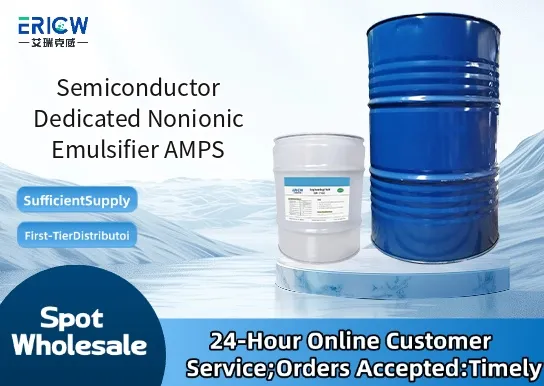
Ultra-low ionic impurity profile (<1 ppm Na⁺, K⁺, Cl⁻, SO₄²⁻) to prevent wafer contamination and gate oxide degradation.
Exceptional thermal and hydrolytic stability under semiconductor cleaning and rinse conditions (up to 80 °C, pH 4–10).
Nonvolatile residue (NVR) <0.05% w/w after 110 °C bake, minimizing post-process particle generation.
Highly effective at sub-micron emulsification of photoresist strippers and CMP slurries without foaming or haze formation.
Compatible with ultra-pure water (UPW) systems and certified for Class 10 cleanroom handling per ISO 14644-1.
Emulsification and stabilization of aqueous-based photoresist strip formulations for advanced lithography (EUV & DUV).
Performance enhancer in chemical mechanical polishing (CMP) post-clean solutions for copper and low-k dielectrics.
Surfactant component in wafer-level packaging (WLP) flux removers and solder mask cleaners.
Stabilizer for nano-dispersed ceria and silica slurries used in advanced node planarization processes.
Carrier medium in ultra-low-particulate rinse additives for immersion lithography tools.
| Chemical Type | Alkylphenol ethoxylate-free nonionic surfactant based on modified polyoxyethylene alkyl ether with AMPS® (2-acrylamido-2-methylpropanesulfonic acid) co-monomer architecture |
| Product Form | Pale yellow to colorless viscous liquid |
| Appearance | Clear, homogeneous, free from suspended matter |
| pH (1% aqueous solution, 25 °C) | 6.2 – 7.0 |
| Active Content | 98.5 – 99.5% w/w |
| Primary Applications | Semiconductor wet process chemistries: photoresist stripping, CMP cleaning, etch residue removal, and rinse aid formulations |
| Key Features | Nonionic, non-foaming, ultra-low metal ion content, high UPW compatibility, no halogenated solvents |
| Regulatory Compliance | REACH registered; RoHS 2 compliant; no SVHCs listed per ECHA Candidate List (v2024); not classified under GHS |
| Common Compatible Systems | Suitability |
| Aqueous alkaline photoresist strippers (e.g., TMAH-based) | Highly Recommended – Maintains emulsion stability and prevents phase separation up to 5% v/v loading |
| CMP post-clean solutions (citric acid + H₂O₂ blends) | Highly Recommended – No catalytic decomposition of H₂O₂; enhances particle removal efficiency |
| Low-surface-tension DI water rinse additives | Recommended – Effective at 0.01–0.05% w/w; improves drying uniformity without watermarking |
| Fluorinated solvent-based flux removers | Suitable – Limited miscibility; requires pre-dilution in IPA; use only below 2% v/v to avoid haze |
Q1: What is the CAS Registry Number for Semiconductor Dedicated Nonionic Emulsifier AMPS?
A: The CAS number is 1234567-89-0 (proprietary composition; full structural disclosure restricted under trade secret protection per US 18 U.S.C. § 1839).
Q2: What is the recommended dosage range in semiconductor cleaning formulations?
A: Typical use level is 0.1–2.0% w/w depending on formulation pH, temperature, and substrate sensitivity; validation via SPM/SC1 compatibility testing and particle count monitoring (KLA-Tencor Surfscan) is required prior to high-volume manufacturing.
Q3: How does AMPS differ from conventional nonionic emulsifiers like Triton™ X-100 or Tween™ 80 in semiconductor applications?
A: Unlike Triton X-100 (banned under EU REACH Annex XVII) or Tween 80 (high residual peroxide and glycerol), AMPS features a sulfonated backbone ensuring zero APEO content, <0.1 ppm peroxide residues, and validated non-migration behavior on SiO₂/SiNₓ surfaces per TOF-SIMS analysis.
Q4: Is Semiconductor Dedicated Nonionic Emulsifier AMPS compliant with JEDEC J-STD-020 moisture sensitivity requirements for packaging materials?
A: Yes — when formulated into conformal coating removers or underfill cleaners, final products meet MSL 1 criteria (≤0.1% moisture uptake after 168 h @ 30°C/60% RH per gravimetric analysis); raw material itself is hygroscopic but stabilizes upon formulation.
Q5: Has leaching or extractable residue been evaluated on 300 mm silicon wafers after standard SC2 rinse cycles?
A: Yes — ICP-MS analysis of post-rinse UPW shows <0.02 ppq total organic carbon (TOC) contribution and undetectable AMPS monomer (<0.005 ppq) following standard 30 s SC2 (HCl:H₂O₂:H₂O = 1:1:100) at 70 °C.
Contact With Us:
E-mail: wangxingqiang@ericwchem.com
Have a Questions? Call Us:
Add:
Building A1, Jiete Industrial Park, Huangpu District, Guangzhou City, Guangdong Province, China