English
 Español
 tiếng việt
 русский
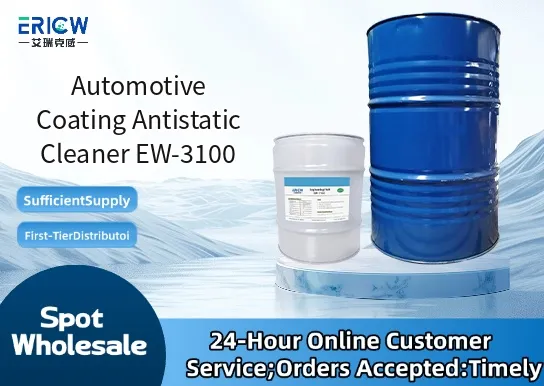
Non-silicone, non-ionic formulation ensures zero interference with subsequent coating adhesion or curing processes.
Fast-evaporating, residue-free cleaning action eliminates static charge buildup on painted automotive surfaces without streaking.
Low-VOC (<50 g/L) and HAPs-free composition supports compliance with global automotive OEM environmental requirements.
Compatible with robotic inline cleaning systems and manual wipe-down operations in high-volume assembly lines.
Stable performance across ambient temperatures (5–40 °C) and relative humidity up to 85% RH.
Prefinal inspection cleaning of electrostatically sensitive painted body panels prior to clearcoat application.
Static mitigation on plastic trim, bumpers, and interior molded components before adhesive bonding or painting.
In-line pre-assembly cleaning of coated door handles, mirror housings, and grilles to prevent dust attraction during packaging.
Post-polishing decontamination of high-gloss exterior finishes to restore surface neutrality before quality gate release.
Cleaning of robotic end-effectors and conveyor fixtures in paint shops to minimize particulate carryover.
| Chemical Type | Non-ionic surfactant blend with volatile organic solvents and antistatic agents |
| Product Form | Liquid (ready-to-use) |
| Appearance | Clear, colorless to pale yellow liquid |
| Odor | Mild, characteristic solvent odor |
| pH (1% aqueous solution) | 6.8–7.2 (at 25 °C) |
| Primary Applications | Static control and precision cleaning of cured automotive coatings and thermoplastic substrates |
| Key Features | Non-corrosive to aluminum, steel, and common automotive plastics; non-yellowing on clearcoats |
| Regulatory Compliance | REACH SVHC-free; compliant with GMW14872, Ford WSS-M2G179-A2, and VDA 278 for low-emission applications |
| Common Compatible Systems | Suitability |
| Electrostatic spray booths (e.g., Dürr EcoRP, Nordson BEVS) | Highly Recommended – No charge disruption; validated for use in ionized environments |
| Robotic wipe systems (e.g., FANUC M-2000iA, ABB IRB 6700) | Highly Recommended – Optimized viscosity and drying rate for automated dispensing and wiping cycles |
| Water-based acrylic topcoats (e.g., BASF CathoGuard® 800 series) | Recommended – No swelling or hazing observed after 72-hour exposure per ASTM D1654 |
| PP/EPDM/TPO automotive trim substrates | Suitable – Passes SAE J2527 UV resistance and ASTM D3359 tape adhesion tests post-cleaning |
Q1: What is the CAS Registry Number for EW-3100?
A: EW-3100 is a proprietary multi-component formulation; individual CAS numbers are not assigned to the finished product. Full component disclosure and SDS are available under NDA upon request.
Q2: What is the recommended application method and typical consumption rate?
A: Apply via low-pressure spray, microfiber wipe, or automated misting system. Typical usage is 80–120 mL/m² for manual operation and 45–75 mL/m² in robotic systems, depending on surface contamination level.
Q3: How does EW-3100 differ from conventional IPA-based cleaners in static control performance?
A: Unlike IPA, EW-3100 incorporates a durable, non-migrating antistatic agent that provides residual surface resistivity reduction (10⁹–10¹⁰ Ω/sq) for up to 72 hours—IPA offers only transient effect (<5 min).
Q4: Is EW-3100 subject to migration or extractables testing per ISO 10993 or USP <87>?
A: Yes—EW-3100 has passed USP <87> cytotoxicity screening and shows no detectable leachables (by GC-MS) from cured automotive coatings under ISO 10993-12 simulated extraction conditions.
Contact With Us:
E-mail: wangxingqiang@ericwchem.com
Have a Questions? Call Us:
Add:
Building A1, Jiete Industrial Park, Huangpu District, Guangzhou City, Guangdong Province, China