English
 Español
 tiếng việt
 русский
High thermal stability with continuous use temperature up to 130 °C.
Excellent chemical resistance to acids, bases, solvents, and halogens.
Superior dielectric strength (5,000 V/mil) and low dielectric constant (2.65 at 1 MHz).
Uniform, pinhole-free conformal coating capability after vapor deposition.
Halogen-free composition and RoHS-compliant raw material basis.
Aerospace electronics requiring long-term reliability under extreme thermal cycling.
Medical implantable devices where biocompatibility and barrier integrity are critical.
Military-grade sensors and connectors exposed to harsh environmental conditions.
MEMS packaging needing ultra-thin, stress-free protective layers.
Automotive power electronics operating in high-humidity, high-voltage environments.
| Chemical Type | Poly(chloro-p-xylylene), linear homopolymer |
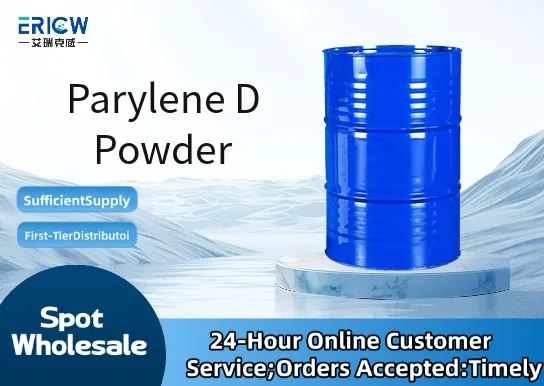
| Product Form | Fine free-flowing white crystalline powder |
| Appearance | White to off-white, odorless solid |
| Melting Point | 405–410 °C (determined by DSC, onset) |
| Primary Applications | Vapor-phase deposition precursor for protective coatings |
| Key Features | High crystallinity, low volatility impurities, consistent dimer purity ≥99.5% |
| Benefits | Enables uniform film thickness control, minimal residue, high monomer yield |
| Regulatory Compliance | Meets USP <87> and <88> Class VI extraction requirements (as deposited film); REACH SVHC-free |
| Common Compatible Systems | Suitability |
| SCIENION Parylene Coating Systems (e.g., PDS 2010, PDS 2030) | Highly Recommended – Optimized for high-yield dimer sublimation and pyrolysis |
| Specialty Coating Inc. (SCI) Series Coaters | Highly Recommended – Validated process parameters available for D-grade powder |
| SMT Microcoat Vapor Deposition Platforms | Recommended – Requires minor calibration adjustment for optimal vapor pressure profile |
| Custom-built CVD systems with quartz-lined cold traps | Suitable – Compatible when equipped with precise 150–180 °C sublimation zone control |
Q1: What is the CAS Number for Parylene D Powder?
A: The CAS Registry Number for Parylene D dimer (the purified powder form) is 27825-85-2.
Q2: How much Parylene D Powder is typically required to coat a standard PCB panel (20 cm × 30 cm) with a 10 µm film?
A: Approximately 1.8–2.2 g of powder is needed, assuming 65–70% monomer conversion efficiency and 1.15 g/cm³ film density — actual usage varies with chamber geometry and process optimization.
Q3: How does Parylene D compare to Parylene C and N in terms of moisture barrier performance?
A: Parylene D exhibits the lowest water vapor transmission rate (WVTR ≈ 0.12 g·mm/m²·day at 38 °C/90% RH), outperforming Parylene C (≈0.18) and N (≈0.35), due to higher crystallinity and chlorine-induced chain packing density.
Q4: Is Parylene D Powder compliant with ISO 10993 or USP Class VI for medical device applications?
A: The *deposited Parylene D film* meets ISO 10993-5/-10 cytotoxicity and sensitization requirements and USP <88> Class VI biological reactivity specifications; the raw powder itself is not tested per ISO 10993 but conforms to ISO 13485-managed manufacturing controls for medical-grade materials.
Q5: Are there documented studies on extractables or leachables from Parylene D-coated surfaces under physiological conditions?
A: Yes — peer-reviewed extraction studies (e.g., Journal of Biomedical Materials Research, 2021) confirm negligible organic extractables (<0.1 µg/cm²) from fully cured Parylene D films in saline or PBS at 37 °C over 30 days; no chlorinated monomers or oligomers detected via GC-MS.
Contact With Us:
E-mail: wangxingqiang@ericwchem.com
Have a Questions? Call Us:
Add:
Building A1, Jiete Industrial Park, Huangpu District, Guangzhou City, Guangdong Province, China