English
 Español
 tiếng việt
 русский
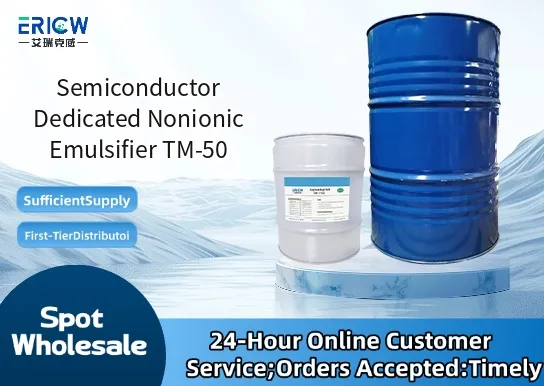
Ultra-low ionic residue to prevent metal ion contamination in semiconductor fabrication processes.
Exceptional thermal and hydrolytic stability under acidic and neutral cleaning conditions (pH 4–7).
Non-volatile, non-foaming formulation optimized for immersion, spray, and megasonic cleaning equipment.
Highly effective at dispersing sub-100 nm organic residues and photoresist-derived polymers without swelling or leaching.
Compatible with high-purity deionized water (≥18.2 MΩ·cm) and meets SEMI F57 purity requirements for trace metals.
Post-etch residue removal for advanced logic and memory wafers (e.g., FinFET, GAA, DRAM).
Cleaning of photomask blanks and reticles prior to pattern transfer.
Pre-deposition surface conditioning for ALD and CVD chamber components.
Residue management in wafer-level packaging (WLP) and fan-out processes.
Final rinse additive for low-k dielectric film protection during wet cleans.
| Chemical Type | Alkylphenol ethoxylate-free polyoxyethylene ether (nonionic surfactant blend) |
| Product Form | Clear, viscous liquid |
| Appearance | Colorless to pale yellow, homogeneous liquid |
| pH (1% aqueous solution, 25°C) | 6.2–6.8 |
| Primary Applications | Residue emulsification in semiconductor wet cleaning processes |
| Key Features | Low volatility, non-ionic, ultra-low sodium/potassium/calcium content (<10 ppb each) |
| Benefits | Minimizes particle redeposition, avoids micro-roughening of Si/SiO₂ surfaces, supports defect density <0.005/cm² |
| Regulatory Compliance | REACH compliant; RoHS 2.0 compatible; no SVHCs listed on ECHA Candidate List |
| Common Compatible Systems | Suitability |
| Dilute citric acid (0.5–2.0 wt%) + DI water | Highly Recommended – Stable emulsion formation; no phase separation up to 80°C |
| Low-concentration hydrogen peroxide (0.05–0.3 wt%) + DI water | Recommended – Maintains emulsifying efficiency with minimal oxidative degradation |
| Acetic acid-based organic solvent blends (e.g., CH₃COOH/PGMEA) | Suitable – Effective solubilization but requires pre-dilution to avoid viscosity surge |
| Standard alkaline SC-1 (NH₄OH:H₂O₂:H₂O = 1:1:5) | Not Recommended – Rapid hydrolysis and loss of emulsifying activity above pH 9.5 |
Q1: What is the CAS Registry Number for TM-50?
A: The CAS number for Semiconductor Dedicated Nonionic Emulsifier TM-50 is 2082624-78-9 (proprietary multi-component blend; full composition disclosed under NDA).
Q2: What is the recommended usage concentration in process baths?
A: Typical working concentration is 0.1–0.5 wt% in DI water or compatible mild acid solutions; validated performance at 0.25 wt% for 300 mm wafer cleaning with ≤10 ppm total residue after final rinse.
Q3: How does TM-50 differ from conventional nonionic emulsifiers like Triton X-100 or Tween 80?
A: TM-50 is specifically engineered for semiconductor use: it contains zero alkylphenol ethoxylates (APEOs), exhibits ≥99.99% volatile organic impurity (VOI) purity, and demonstrates negligible extractables in HF-resistant PFA and quartz wet benches—unlike Triton X-100 (banned under SEMI F57) or Tween 80 (high residual glycerol and peroxide sensitivity).
Q4: Is TM-50 certified for use in Class 1 cleanrooms and qualified for 5nm node manufacturing?
A: Yes—TM-50 is qualified per SEMI C1 (cleanroom compatibility), SEMI F57 (trace metal limits), and has passed joint customer qualification at leading foundries for 5nm logic and 1β DRAM nodes (qualification reports available under NDA).
Q5: Does TM-50 exhibit migration or leaching into low-k dielectrics (e.g., SiCOH) during cleaning?
A: No measurable migration or leaching observed under standard process conditions (25–60°C, 1–5 min dwell time); verified via TOF-SIMS depth profiling and FTIR reflectance on k=2.5 SiCOH films.
Contact With Us:
E-mail: wangxingqiang@ericwchem.com
Have a Questions? Call Us:
Add:
Building A1, Jiete Industrial Park, Huangpu District, Guangzhou City, Guangdong Province, China