English
 Español
 tiếng việt
 русский
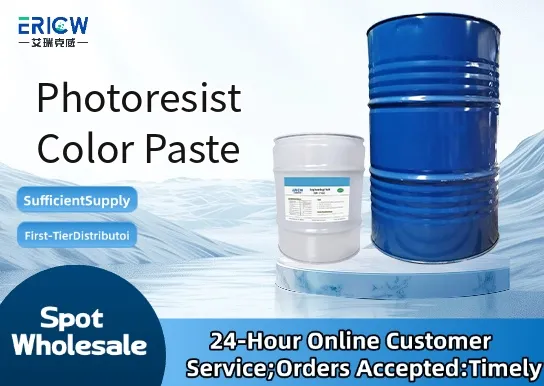
High chroma pigment dispersion ensures consistent, vibrant coloration in photoresist films without agglomeration.
Optimized rheology for seamless integration into standard photolithography coating processes (spin-coating, slit-die, inkjet).
Thermal and UV stability preserves color fidelity during pre-bake, exposure, and post-exposure bake (PEB) steps.
Low ionic impurity content minimizes device leakage and enhances pattern fidelity in high-resolution microstructures.
Compatible with both positive and negative tone photoresist chemistries across g-, h-, and i-line exposure systems.
Color filter array (CFA) fabrication for LCD and OLED display backplanes.
Micro-optical elements including waveguides, diffractive lenses, and AR/VR combiner layers.
Functional patterning in MEMS packaging for visual alignment marks and process identification.
Decorative and functional thin-film coatings on semiconductor sensors and IC substrates.
Photonic integrated circuit (PIC) process monitoring layers requiring non-intrusive optical contrast.
| Chemical Type | Organic pigment-based dispersion in acrylic resin matrix with proprietary stabilizers |
| Product Form | Viscous, non-settling liquid paste (ready-to-dilute) |
| Appearance | Homogeneous, glossy paste; color varies by formulation (e.g., R301, G502, B703) |
| Melting Point / Softening Range | No sharp melting point; gradual softening above 85 °C |
| Primary Applications | Color filter layers, optical alignment aids, process visualization markers |
| Key Features | Non-bleeding, low outgassing, solvent-compatible (PGMEA, EL, cyclohexanone) |
| Benefits | Enables <10 µm feature definition; supports <0.35 µm resolution after development |
| Regulatory Compliance | RoHS 2015/863 compliant; REACH SVHC-free; no intentionally added PFAS |
| Common Compatible Systems | Suitability |
| TOK® PAK series (e.g., PAK-5000, PAK-7000) | Highly Recommended – Demonstrated compatibility with thermal crosslinking and high-resolution patterning |
| JSR® TMMR series (e.g., TMMR-L100, TMMR-H100) | Recommended – Requires minor dilution optimization; stable under standard i-line exposure |
| Sumitomo Chemical® S-1000 series | Suitable – Validated for color filter applications; may require extended pre-bake for full solvent removal |
| DOW® XP series (e.g., XP-1000) | Recommended – Compatible with aqueous developable formulations; verified adhesion on ITO/glass substrates |
Q1: What is the CAS Registry Number for Photoresist Color Paste?
A: This is a multi-component formulation; individual pigment and resin components have distinct CAS numbers (e.g., Pigment Red 254: 37138-24-2). Full compositional disclosure is provided under NDA upon request.
Q2: What is the typical recommended dosage when blending into photoresist?
A: Standard loading range is 3–12 wt% relative to the base resist polymer solution, depending on required optical density and process window. Optimization via DOE is advised for critical applications.
Q3: How does it differ from conventional dye-based colorants in photoresists?
A: Unlike dyes, our pigment-based paste offers superior photostability, negligible migration during thermal cycling, and no solubility-induced blurring—critical for sub-micron registration accuracy.
Q4: Is extraction testing data available for food-contact or medical device applications?
A: Not applicable — this product is intended solely for electronic materials processing and is not formulated or qualified for direct food-contact or implantable medical use.
Q5: Has migration testing been performed under accelerated aging conditions (e.g., 85°C/85% RH)?
A: Yes — validated per JEDEC JESD22-A101 for 1000 hours at 85°C/85% RH shows no detectable pigment migration (<0.1 ppm) into adjacent dielectric layers.
Contact With Us:
E-mail: wangxingqiang@ericwchem.com
Have a Questions? Call Us:
Add:
Building A1, Jiete Industrial Park, Huangpu District, Guangzhou City, Guangdong Province, China