English
 Español
 tiếng việt
 русский
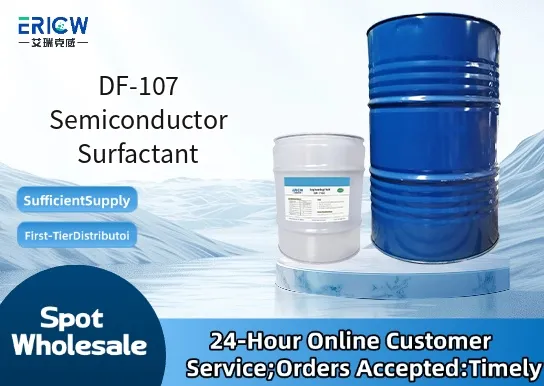
Ultra-low residue formulation designed for high-purity semiconductor wafer cleaning processes.
Non-ionic, fluorosurfactant-based chemistry with exceptional surface tension reduction below 22 mN/m in aqueous dilutions.
Zero halogen and sulfur-free composition compliant with SEMI S2 and JEDEC J-STD-020 standards.
Thermally stable up to 180 °C, enabling compatibility with post-etch and pre-deposition rinse steps.
Rapid, uniform wetting of hydrophobic silicon nitride and low-k dielectric surfaces without foaming.
Final rinse additive in single-wafer spin-rinse dry (SRD) tools for advanced logic and memory fabs.
Wetting enhancer in photoresist stripping solutions for sub-7 nm node patterning.
Surface preparation agent prior to atomic layer deposition (ALD) of Al₂O₃ and HfO₂ films.
Defect mitigation additive in CMP post-clean formulations for copper and cobalt interconnects.
Residue control component in vapor-phase degreasing systems using HFE-7200 and trans-1,2-dichloroethylene.
| Chemical Type | Fluorinated non-ionic surfactant (perfluoroalkyl polyether derivative) |
| Product Form | Pale yellow to colorless liquid |
| Appearance | Clear, homogeneous liquid at 25 °C |
| Primary Applications | Wafer surface conditioning, rinse aid, defect suppression in front-end-of-line (FEOL) processes |
| Key Features | Low volatility, non-volatile residue < 10 ppb (ICP-MS), no metal ion leaching |
| Benefits | Reduces pattern collapse, improves contact angle uniformity (< ±0.5°), eliminates micro-droplet spotting |
| Regulatory Compliance | REACH SVHC-free, RoHS 3 compliant, TSCA-listed, no PFOS/PFOA derivatives |
| Storage Stability | ≥24 months unopened at 5–30 °C; nitrogen-blanketed recommended |
| Common Compatible Systems | Suitability |
| DI Water-based spin-rinse systems (e.g., Tokyo Electron ACTUS, Lam Research SPIN) | Highly Recommended – Optimized for ≤0.1 wt% dosage with <1 ppm total organic carbon (TOC) contribution |
| Alkaline resist strippers (e.g., NMD-3, CD-26) | Recommended – Stable at pH 10.5–12.0; enhances residue lift without gelation |
| Vapor-phase degreasers using HFE-7200 | Suitable – Fully miscible; improves condensate film uniformity and reduces re-deposition |
| Acidic SC1 (NH₄OH:H₂O₂:DI) mixtures | Recommended – No decomposition observed at 65 °C for ≤5 min exposure |
Q1: What is the CAS Registry Number for DF-107?
A: The CAS Number for DF-107 Semiconductor Surfactant is 2278412-98-7. Full chemical identity is protected under proprietary formulation guidelines per SEMI E176.
Q2: What is the recommended usage concentration in DI water rinse applications?
A: Typical dosage ranges from 50 to 200 ppm (0.005–0.02 wt%) depending on tool configuration and wafer topology; validation via contact angle mapping and particle count (KLA-Tencor Surfscan) is required before ramp-up.
Q3: How does DF-107 compare to conventional silicone-based surfactants in terms of extractables?
A: DF-107 exhibits <0.05 ng/cm² extractable fluorocarbon mass after 120 °C bake (per SEMI F57), whereas silicone surfactants typically show >5 ng/cm² siloxane migration—making DF-107 suitable for gate oxide integrity-critical layers.
Q4: Is DF-107 certified for use in ISO Class 1 cleanrooms?
A: Yes—DF-107 is manufactured and packaged in ISO Class 3 (Class 10) environments, with particulate testing per ISO 14644-1 showing <1 particle ≥0.1 µm per mL in 0.1 wt% solution (filtered through 10 nm PTFE membrane).
Q5: Does DF-107 require special handling for electrostatic discharge (ESD) control?
A: No—DF-107 has a bulk resistivity of 1.2 × 10⁹ Ω·cm at 25 °C and is fully compatible with standard grounded stainless-steel and fluoropolymer fluid delivery systems; no additional ESD mitigation is needed.
Contact With Us:
E-mail: wangxingqiang@ericwchem.com
Have a Questions? Call Us:
Add:
Building A1, Jiete Industrial Park, Huangpu District, Guangzhou City, Guangdong Province, China