English
 Español
 tiếng việt
 русский
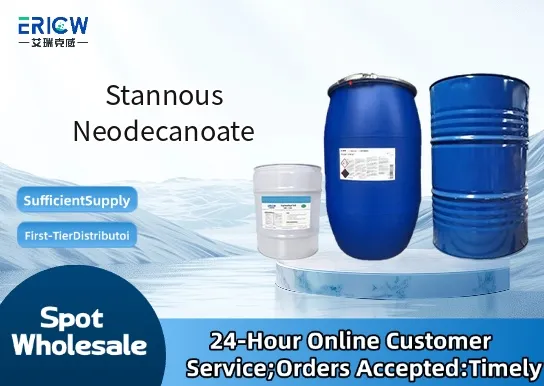
High catalytic activity for urethane and esterification reactions at ambient to moderate temperatures.
Excellent solubility in common organic solvents including aromatic hydrocarbons, ketones, and polyester polyols.
Low volatility and thermal stability up to 180 °C, minimizing catalyst loss during processing.
Reduced tendency to cause discoloration compared to traditional tin(II) carboxylates.
Non-hygroscopic liquid form ensures consistent dosing and handling safety.
Catalyst for moisture-cure polyurethane sealants and adhesives.
Accelerator in one-component (1K) polyurethane coating systems.
Promoter in silicone-based RTV-2 condensation-cure elastomers.
Co-catalyst in alkyd resin synthesis and crosslinking reactions.
Reaction modifier in bio-based polyol transesterification processes.
| Chemical Type | Tin(II) salt of branched-chain neodecanoic acid |
| Product Form | Clear, pale yellow to amber viscous liquid |
| Appearance | Homogeneous, free from visible particulates or sediment |
| Tin Content (as Sn) | 17.0 – 19.0 wt% |
| Acid Value (mg KOH/g) | ≤ 5.0 |
| Density (25 °C, g/cm³) | 1.02 – 1.06 |
| Viscosity (25 °C, cP) | 300 – 800 |
| Regulatory Compliance | REACH registered; compliant with EU RoHS Directive (2011/65/EU); not classified as hazardous under GHS Rev. 9 |
| Common Compatible Systems | Suitability |
| Polyester Polyols (e.g., adipate- and phthalate-based) | Highly Recommended – Rapid gel time control without side reactions |
| Aromatic Isocyanates (TDI, MDI, polymeric MDI) | Highly Recommended – Efficient NCO–OH reaction promotion |
| Alkoxysilane-terminated prepolymers | Recommended – Effective moisture cure initiation with low odor |
| Acetoxy-cure silicone systems | Suitable – Moderate acceleration; requires compatibility testing for shelf life |
Q1: What is the CAS Number for Stannous Neodecanoate?
A: The CAS Registry Number is 301-10-0.
Q2: What is the typical usage level in polyurethane sealants?
A: Standard dosage ranges from 0.05% to 0.3% by weight relative to total formulation, depending on cure speed requirements and base polymer reactivity.
Q3: How does it compare to dibutyltin dilaurate (DBTDL) in terms of regulatory acceptance?
A: Unlike DBTDL (CAS 77-58-7), Stannous Neodecanoate is not listed as a Substance of Very High Concern (SVHC) under REACH and exhibits lower aquatic toxicity, supporting broader global market access.
Q4: Is Stannous Neodecanoate prone to migration or extractable tin in end-use applications?
A: Due to its high molecular weight and covalent integration into polymer networks, extractable tin levels remain well below 0.1 ppm in fully cured systems per EN 1122 and US FDA 21 CFR §175.105 testing protocols.
Contact With Us:
E-mail: wangxingqiang@ericwchem.com
Have a Questions? Call Us:
Add:
Building A1, Jiete Industrial Park, Huangpu District, Guangzhou City, Guangdong Province, China