English
 Español
 tiếng việt
 русский
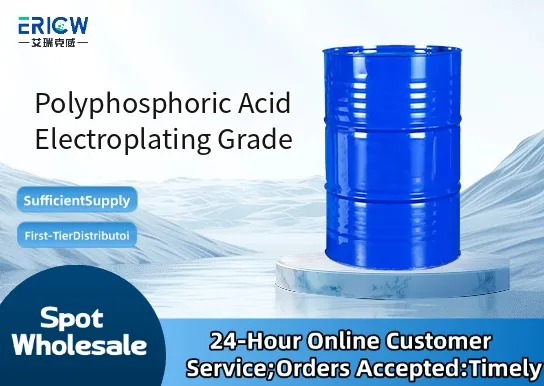
Ultra-low metal impurity profile (Fe < 5 ppm, Cu < 1 ppm, Ni < 0.5 ppm) for high-purity electrochemical deposition.
Controlled polymeric chain distribution ensuring consistent viscosity and bath stability during plating operations.
Optimized phosphoric acid to phosphorus pentoxide (P₂O₅) ratio (~83–85 wt%) for enhanced complexation of metal ions without excessive hydrolysis.
Non-volatile, non-oxidizing acidic medium that minimizes anode passivation and improves current efficiency in nickel and cobalt electroplating baths.
Batch-certified traceability with full CoA (Certificate of Analysis) including ICP-MS heavy metal screening.
Nickel-phosphorus (Ni-P) electroless plating baths requiring precise acid buffering and complex stabilization.
Cobalt-based alloy plating formulations for wear-resistant and magnetic coatings in aerospace components.
Electrodeposition of functional nanocomposite coatings (e.g., Ni-SiC, Co-PTFE) where acid purity directly impacts particle dispersion.
Pre-treatment and activation solutions for aluminum and magnesium substrates prior to multi-layer plating.
Specialty anodizing electrolytes for high-precision optical and semiconductor tooling applications.
| Chemical Type | Condensed phosphoric acid mixture (predominantly H₄P₂O₇, H₅P₃O₁₀, and higher oligomers) |
| Product Form | Clear, viscous liquid at room temperature |
| Appearance | Colorless to pale straw-yellow, free from suspended solids or phase separation |
| Melting Point | Approx. 61–65 °C (solidifies upon cooling; supplied as stabilized melt) |
| Primary Applications | Electroplating bath additive, complexing agent, pH stabilizer, and catalyst carrier |
| Key Features | Low volatility, high thermal stability (>250 °C), negligible sulfate/chloride contamination |
| Benefits | Extends bath life, reduces sludge formation, improves deposit uniformity and adhesion |
| Regulatory Compliance | REACH SVHC-free; compliant with RoHS Directive 2011/65/EU Annex II (as supplied) |
| Common Compatible Systems | Suitability |
| Nickel Sulfamate Plating Baths | Highly Recommended – Enhances conductivity and suppresses hydrolysis without interfering with brightener performance |
| Acidic Cobalt Fluoroborate Electrolytes | Recommended – Improves cathode efficiency and grain refinement in hard cobalt deposits |
| Electroless Ni-P Bath Stabilizers | Highly Recommended – Replaces conventional stabilizers (e.g., thiourea) with lower risk of co-deposition defects |
| Alkaline Zinc-Nickel Plating Additives | Suitable – Used as a controlled acid source for localized pH adjustment in mixed-metal systems |
Q1: What is the CAS Number for Polyphosphoric Acid Electroplating Grade?
A: The registered CAS Number is 8017-24-9, corresponding to technical-grade polyphosphoric acid; this grade is further purified and certified per electroplating-specific impurity limits.
Q2: What is the typical dosage range in electroplating baths?
A: Recommended concentration is 0.5–3.0 g/L, depending on bath composition and operating temperature; start at 1.0 g/L and optimize via Hull cell testing for deposit quality and throwing power.
Q3: How does it differ from orthophosphoric acid (H₃PO₄) in plating applications?
A: Unlike orthophosphoric acid, polyphosphoric acid provides stronger chelation of transition metals, reduced water activity, and superior thermal/chemical stability—minimizing hydrogen evolution and enabling higher current densities without burning.
Q4: Is migration or leaching into plated layers a concern?
A: No significant phosphorus migration occurs under standard plating conditions; residual phosphorus remains bound in the electrolyte or forms inert surface complexes, with no detectable incorporation into Ni-P or Co-P deposits per XPS analysis (detection limit < 0.02 at%).
Q5: Does this product meet ISO 14001 or IATF 16949 manufacturing requirements?
A: Yes—the production facility is certified to ISO 14001:2015 and IATF 16949:2016; each batch undergoes environmental compliance review, and full traceability documentation is provided with shipment.
Contact With Us:
E-mail: wangxingqiang@ericwchem.com
Have a Questions? Call Us:
Add:
Building A1, Jiete Industrial Park, Huangpu District, Guangzhou City, Guangdong Province, China