English
 Español
 tiếng việt
 русский
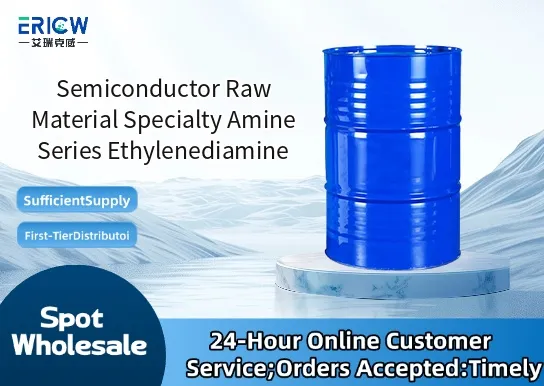
Ultra-high purity (≥99.99% GC), rigorously controlled for trace metal content (<10 ppb Na, K, Ca, Fe, Cu) to prevent semiconductor process contamination.
Low volatility and enhanced thermal stability—optimized for high-temperature CVD and ALD precursor formulations without premature decomposition.
Controlled amine reactivity profile: balanced nucleophilicity and chelation strength for selective metal complexation in advanced etch and cleaning chemistries.
Batch-to-batch consistency certified via NMR, FT-IR, and ICP-MS; full traceability with CoA and CoC documentation per shipment.
Manufactured under ISO 9001 and ISO 14001 certified cleanroom conditions with dedicated stainless-steel distillation and packaging lines.
Chelating ligand in copper and cobalt precursors for atomic layer deposition (ALD) of interconnect barrier layers.
Key component in high-selectivity post-CMP cleaning formulations for removal of residual metal ions and organic residues.
Stabilizer and co-ligand in photoresist development accelerators for advanced EUV lithography processes.
Functional additive in low-k dielectric pore-sealing solutions to enhance mechanical integrity and moisture resistance.
Reaction intermediate in synthesis of nitrogen-doped carbon nanotube catalysts used in semiconductor-grade graphene transfer processes.
| Chemical Type | Aliphatic diamine (1,2-ethanediamine) |
| Product Form | Liquid, supplied in sealed, double-contained electropolished stainless-steel cylinders (1–5 kg) |
| Appearance | Clear, colorless to pale yellow liquid; no visible particulates or phase separation |
| Melting Point | 8.5–10.5 °C |
| Boiling Point (760 mmHg) | 116–118 °C |
| Primary Applications | ALD/CVD precursor synthesis, CMP cleaning additives, EUV resist additives, low-k sealants |
| Key Features | Ultra-low metals, low water content (<50 ppm), strict control of diethylenetriamine impurity (<50 ppm) |
| Regulatory Compliance | REACH compliant; non-REACH SVHC listed; fully documented SDS per GHS Rev. 10 |
| Common Compatible Systems | Suitability |
| Cu(hfac)₂-based ALD precursor systems | Highly Recommended – Enables stable, volatile complexes with improved film uniformity and reduced carbon incorporation |
| Post-CMP alkaline cleaning platforms (e.g., NH₃/H₂O₂ blends) | Recommended – Enhances chelation-driven ion removal without compromising surface roughness |
| EUV photoresist developer concentrates (TMAH-based) | Suitable – Acts as mild accelerator with negligible impact on resolution or LWR |
| Organosilicon low-k pore sealing formulations | Highly Recommended – Improves crosslinking density and reduces moisture uptake at 3nm node scaling |
Q1: What is the CAS Registry Number for this specialty ethylenediamine grade?
A: The CAS number is 107-15-3. This refers to the base ethylenediamine molecule; our semiconductor-grade material carries additional batch-specific purity identifiers and QC certification codes traceable to each cylinder.
Q2: What is the recommended handling concentration when used as a chelator in CMP slurry formulations?
A: Typical working concentrations range from 0.05 to 0.5 wt% in final slurry, depending on metal ion load and pH. We recommend initial qualification at 0.1 wt% with rigorous particle count and zeta potential monitoring.
Q3: How does this grade differ from commercial-grade ethylenediamine (e.g., ACS reagent or technical grade)?
A: Unlike standard grades, our semiconductor variant undergoes multi-stage fractional distillation under inert atmosphere, followed by sub-micron filtration and metal-scavenging purification. It meets SEMI C12 purity standards and excludes common impurities like piperazine, triethylenetetramine, and aldehydes that induce defect formation.
Q4: Is there data available on extractables/migration in contact with fluoropolymer wet process components (e.g., PFA, ETFE)?
A: Yes—migration studies per SEMI F57-0318 show <0.02 ng/cm² leachable amines after 72 h exposure at 60 °C in PFA-lined containers. Full extractables report (IC, LC-MS/MS) is provided with every CoA.
Q5: Does this material comply with USP <846> or EP 2.2.46 for elemental impurities in pharmaceutical intermediates?
A: While primarily designed for semiconductor use, it exceeds USP <846> Class 1 and Class 2 elemental limits (Pb, Cd, As, Hg, Co, V, Ni, etc.) by ≥10×, and is routinely qualified for dual-use applications requiring both SEMI and ICH Q3D alignment.
Contact With Us:
E-mail: wangxingqiang@ericwchem.com
Have a Questions? Call Us:
Add:
Building A1, Jiete Industrial Park, Huangpu District, Guangzhou City, Guangdong Province, China