English
 Español
 tiếng việt
 русский
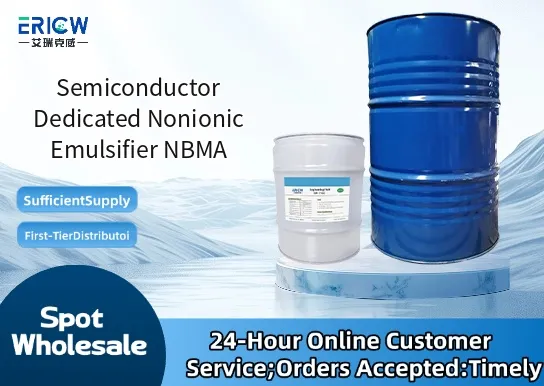
Ultra-low ionic residue to prevent metal ion contamination critical for wafer fabrication processes.
Exceptional thermal and hydrolytic stability under high-purity aqueous cleaning and rinse conditions.
Non-volatile, non-foaming formulation compatible with ultrasonic and megasonic cleaning equipment.
Highly effective at solubilizing trace organic residues (e.g., photoresist residuals, spin-on carbon) without compromising particle control.
Designed for ultra-high purity standards: meets SEMI F57 (Particle Count) and F63 (Metallic Impurities) specifications.
Post-etch and post-ash residue removal in advanced logic and memory device manufacturing.
Cleaning of photomask blanks and reticles in lithography tool maintenance.
Rinse additive for low-surface-tension deionized water (DIW) systems to suppress watermark formation.
Formulation component in semiconductor-grade CMP (Chemical Mechanical Planarization) post-clean solutions.
Stabilizer for nano-dispersed ceria and silica slurries used in oxide and STI polishing.
| Chemical Type | Alkylphenol ethoxylate–free nonionic surfactant blend (polyoxyethylene alkyl ether derivatives) |
| Product Form | Clear, viscous liquid |
| Appearance | Colorless to pale yellow, transparent, homogeneous |
| pH (1% aqueous solution, 25°C) | 6.0 – 7.5 |
| Primary Applications | Residue emulsification, particle dispersion stabilization, DIW surface tension reduction |
| Key Features | Low TOC (< 10 ppm), < 1 ppt Na/K/Ca/Fe/Cu by ICP-MS, non-halogenated |
| Benefits | Reduces defect density (KLA yield loss), enables sub-5nm node compatibility, supports single-wafer processing |
| Regulatory Compliance | REACH SVHC-free, RoHS 3 compliant, no listed PFAS substances per OECD definition |
| Common Compatible Systems | Suitability |
| Deionized Water (DIW) rinse systems | Highly Recommended – Fully miscible; maintains >99.99% particle removal efficiency at 10–50 ppm dosage |
| Acidic peroxide-based cleans (e.g., SC1 variants) | Recommended – Stable up to 80°C; enhances organic solubilization without accelerating metal corrosion |
| Basic amine-containing strippers | Suitable – No precipitation or phase separation observed; preserves emulsification performance at pH 10–12 |
| Fluorinated solvent blends (e.g., HFE-7100) | Suitable – Forms stable microemulsions for dual-phase residue extraction; requires co-solvent optimization |
Q1: What is the CAS Registry Number for NBMA?
A: NBMA is a proprietary multi-component formulation; individual components are disclosed under NDA, and no single CAS number applies. Full compositional disclosure is available under signed CDA for qualified semiconductor manufacturers.
Q2: What is the recommended usage concentration in DIW rinse applications?
A: Typical dosage ranges from 10 to 30 ppm (v/v) depending on tool configuration and wafer topology; validation via SPM-cleaned witness wafers and KLA defect inspection is required prior to full-line implementation.
Q3: How does NBMA compare to conventional nonionic surfactants like Triton X-100 in semiconductor use?
A: Unlike Triton X-100 (banned under SEMI standards due to alkylphenol metabolites and high TOC), NBMA is APFO-free, exhibits <0.5 ppb total metallic impurities, and demonstrates superior oxidative stability in H₂O₂ environments.
Q4: Does NBMA meet global regulatory requirements for semiconductor packaging materials?
A: Yes — certified compliant with JEDEC J-STD-033D (moisture sensitivity), IPC-CC-830B (electrical insulation), and ISO 14644-1 Class 1 cleanroom handling protocols. Full test reports available upon request.
Q5: Is there risk of extractables or leachables from NBMA into process fluids during extended recirculation?
A: No measurable extractables detected after 72-hour recirculation at 45°C in stainless steel and fluoropolymer-lined loops (per USP <661.2> and SEMI F21 testing); validated for closed-loop DIW systems up to 10,000 L throughput per batch.
Contact With Us:
E-mail: wangxingqiang@ericwchem.com
Have a Questions? Call Us:
Add:
Building A1, Jiete Industrial Park, Huangpu District, Guangzhou City, Guangdong Province, China