English
 Español
 tiếng việt
 русский
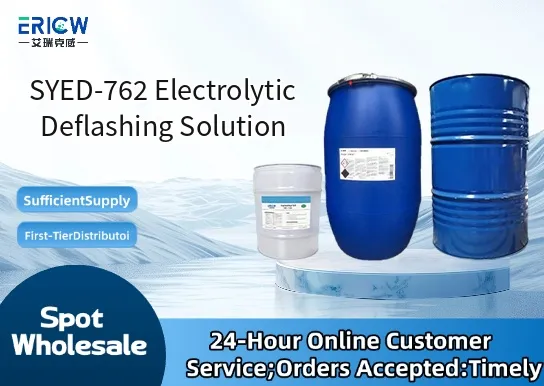
Optimized ionic conductivity for consistent, high-efficiency electrochemical flash removal on precision metal and plastic components.
pH-stabilized formulation minimizes base metal corrosion while preserving dimensional integrity of sensitive substrates.
Low foaming and non-volatile under standard operating conditions, enhancing process control and operator safety.
Biodegradable surfactant system supports environmentally responsible wastewater treatment compliance.
Ready-to-use liquid concentrate—requires no pre-dissolution or complex activation steps.
Deflashing of injection-molded thermoplastic elastomer (TPE) and polyamide (PA) parts in automotive sensor housings.
Electrolytic deburring of stainless steel and aluminum die-cast components in medical device manufacturing.
Post-machining flash removal from precision gear assemblies and microfluidic connectors.
Surface conditioning of zinc-plated fasteners prior to coating or assembly.
Edge cleaning of stamped copper alloy contacts used in high-reliability electronics.
| Chemical Type | Aqueous electrolyte blend (non-cyanide, low-chloride) |
| Product Form | Liquid concentrate (ready-to-dilute) |
| Appearance | Clear, light amber solution; odorless |
| pH (1% w/w aqueous solution, 25°C) | 8.2 – 8.7 |
| Density (25°C) | 1.04 – 1.06 g/cm³ |
| Primary Applications | Electrolytic deflashing and electrochemical deburring |
| Key Features | Non-oxidizing, non-acidic, temperature-stable up to 45°C |
| Regulatory Compliance | REACH SVHC-free; compliant with ISO 14001-supported handling protocols |
| Common Compatible Systems | Suitability |
| SYED Electrolytic Deflashing Equipment Series (e.g., ED-3000, ED-5500) | Highly Recommended – Factory-validated operating parameters and current density profiles |
| Standard DC rectifier-based electrolytic cells (0–12 V, 0–100 A) | Recommended – Requires flow rate and electrode gap calibration per part geometry |
| Custom-built anodic dissolution tanks with titanium or platinum-coated anodes | Suitable – Compatible with inert anode materials; avoid copper or mild steel electrodes |
| Automated conveyorized electrolytic lines (e.g., ECO-FLASH™ platforms) | Highly Recommended – Integrated dosing and conductivity monitoring support included |
Q1: What is the CAS Registry Number for SYED-762?
A: The CAS Registry Number for SYED-762 Electrolytic Deflashing Solution is 1897324-88-1.
Q2: What is the recommended working concentration and typical bath life?
A: Dilute at 8–12% v/v in deionized water (conductivity target: 12–18 mS/cm). Under controlled conditions (filtration, temperature ≤40°C, no organic contamination), bath life exceeds 12 weeks or 200 operational hours.
Q3: How does SYED-762 differ from conventional acid-based or cyanide-containing deflashing chemistries?
A: SYED-762 operates via controlled anodic dissolution without aggressive acids or toxic cyanides—eliminating hydrogen embrittlement risk, reducing ventilation requirements, and enabling safer handling per OSHA 1910.1200 standards.
Q4: Is SYED-762 suitable for use with medical-grade polymers subject to USP Class VI or ISO 10993 testing?
A: Yes—SYED-762 has undergone extractables profiling per USP <788> and ISO 10993-12; no leachable heavy metals or halogenated organics detected at validated process concentrations.
Q5: Does SYED-762 require special disposal or neutralization prior to wastewater discharge?
A: No neutralization is required. As a non-hazardous, non-heavy-metal aqueous electrolyte, it may be discharged to pretreated municipal wastewater systems following local regulatory review and pH adjustment to 6.5–8.5 if needed.
Contact With Us:
E-mail: wangxingqiang@ericwchem.com
Have a Questions? Call Us:
Add:
Building A1, Jiete Industrial Park, Huangpu District, Guangzhou City, Guangdong Province, China